Leaders of the Islamic Republic made a lot of assumptions about rank-and-file Iranians, it turns out, that are now emphatically聽proving to be untrue. This is a story about the public pressure that can build over decades of promises unfulfilled.
Our name is about honesty. The Monitor is owned by The First Church of Christ, Scientist, and we鈥檝e always been transparent about that.
The church publishes the Monitor because it sees good journalism as vital to progress in the world. Since 1908, we鈥檝e aimed 鈥渢o injure no man, but to bless all mankind,鈥 as our founder, Mary Baker Eddy, put it.
Here, you鈥檒l find award-winning journalism not driven by commercial influences 鈥 a news organization that takes seriously its mission to uplift the world by seeking solutions and finding reasons for credible hope.
About usAlready a subscriber? Log in
Already have a subscription? Activate it
Join the Monitor community.
Subscribe
Clayton Collins
Sometimes good news deserves a harder look, too.
You don鈥檛 need to have just endured a 聽to be cheered by actions to reduce carbon emissions, widely held to be at least one factor in the climate change behind extreme weather.
The new year brought a new in China, aimed at mitigating the effects of rapid industrialization. In its bid to become a green leader, China has taken a range of , including ending its handling of many of the world鈥檚 recyclables (it says it found hazardous waste in too many of them).
But China took in more than half of the world鈥檚 plastic last year. So as with Beijing鈥檚 , which critics say will just push the illegal trade to harder-to-police hubs in Laos and elsewhere, the ripples of nice-sounding moves sometimes only amount to displacement.
I caught the Monitor鈥檚 Michael Holtz in Beijing just before he went to bed. Yes, 鈥渨hile China is closing many of its own coal-fired power plants,鈥 he pointed out, 鈥渋t also has plans to build new ones overseas.鈥
That鈥檚 social responsibility tempered by global economic competitiveness. Is the grass-roots thinking among those in China鈥檚 rising generation any different? Michael鈥檚 roommate had just shown him a new app that monitors socially responsible behavior 鈥 using bike shares, taking receipts by email, repurposing rather than discarding. Get points, and the app arranges for a tree-planting on your behalf.
That鈥檚 personal 鈥 and global.
Now to our five stories for today, intended to rise above the daily churn to focus on understanding the needs and motives of others 鈥 as well as our own.聽
Already a subscriber? Log in
Monitor journalism changes lives because we open that too-small box that most people think they live in. We believe news can and should expand a sense of identity and possibility beyond narrow conventional expectations.
Our work isn't possible without your support.
And why we wrote them
( 6 min. read )
Leaders of the Islamic Republic made a lot of assumptions about rank-and-file Iranians, it turns out, that are now emphatically聽proving to be untrue. This is a story about the public pressure that can build over decades of promises unfulfilled.
( 5 min. read )
Some party alignment, needless to say, is critical for party survival. Think of a slightly less ominous variation on Benjamin Franklin鈥檚 鈥渉ang together鈥 line. For this year to work out for Republicans, the president may need to match party leaders鈥 willingness to put personal differences aside. 聽
( 7 min. read )
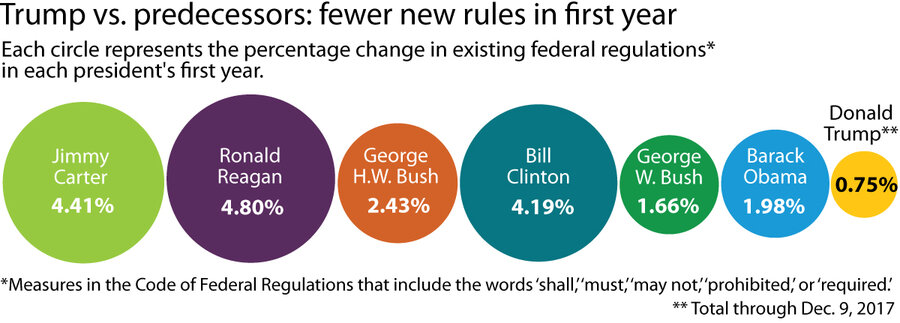
Apart from stirring hot reactions 鈥 enthusiasm over big stock market gains, criticism over moves like Thursday鈥檚 announced expansion of 鈥 President Trump is trying to do something that has proved historically difficult: to halt or even reverse the growing body of federal rules. It's not clear if he'll achieve this.
( 5 min. read )
At our morning planning meetings we have stories that are 鈥渢alkers.鈥 This was one. Humans are primed to look for driving forces in the world around us, ones that we can explain though our own collective experience. That鈥檚 鈥減art of what it means to be a thinking human,鈥 as one of our science writers put it. It鈥檚 also what drives our desire to discover.
( 4 min. read )
Peter Rainer is a pretty tough grader, so when he sends in a review marked 'A-,' we make plans to add his pick to our Netflix queues. If you read Peter鈥檚 best-of-2017 column then you have an idea where he stands on Daniel Day-Lewis鈥檚 latest (and reportedly last) film. Here鈥檚 his full critique.聽
( 3 min. read )
Rita Joy Osazee, a refugee who fled from Nigeria, is training to work in an elder care facility in Budapest, Hungary. 鈥淚t is not easy to be old,鈥 she says. 鈥淚 feel a strong desire to take care of the elderly. I don鈥檛 know why but I just love them.鈥
Iman Khatibe escaped the brutal civil war in Syria and has found a new home in Frankfurt, Germany, as a seamstress. She learned her skills from her mother, aunt, and uncle; now she designs and makes garments from evening dresses to wedding gowns, decorated with her own intricate embroidery. 鈥淚 don鈥檛 copy what I see on the street,鈥 she says. 鈥淢y inspiration comes from inside.鈥
The United Nations High Commissioner for Refugees (UNHCR) collects and tells stories such as these to help remove stereotypes about who refugees are. Each individual has a unique situation; what they share are lives that, through no fault of their own, have been severely disrupted.
The UNHCR calculates that worldwide 22.5 million refugees have fled their homelands based on well-founded fears of persecution because of their religion, nationality, race, or politics. If a broader definition is used that includes people displaced within their own countries, the figure rises to 65.6 million 鈥 the highest number since the massive refugee crisis that sprang from World War II more than 70 years ago.
Today, while record numbers need help, the United States has set a record of its own: In 2017 the US accepted the fewest number of refugees, just 29,022, since at least 2002, the year after the 9/11 terrorist attacks.
The US took in 84,995 refugees in the last fiscal year of the Obama administration that ended in September 2016. In 1980 the Reagan administration took in more than 200,000 refugees. The Trump administration has set a limit of 45,000 admissions for 2018.
The seesaw political arguments over the benefits and dangers of immigration are well known. This much certainly can be said: Throughout American history immigrants have been the engine of growth and prosperity. And given today鈥檚 low unemployment many areas of the country face worker shortages that immigrants could fill.
Refugees, however, represent a special 鈥 and tiny 鈥 part of the immigrant story (about 1 million legal immigrants are added to the US population each year). In many cases refugees literally have fled for their lives. Nations that take them in make a statement about their moral commitment to help those in clear and urgent need.
In his recent Christmas message Pope Francis compared the plight of refugee children to Jesus, who after his birth was forced to flee Bethlehem with his parents, crossing into neighboring Egypt to escape harm.聽
鈥淲e see Jesus in the many children forced to leave their countries to travel alone in inhuman conditions and who become an easy target for human traffickers,鈥 he said. 鈥淭hrough their eyes we see the drama of all those forced to emigrate and risk their lives to face exhausting journeys....鈥
In guiding US policy, fears that refugees bring with them crime, or even terrorism, or that they will put severe or unfair demands on social services, need to be weighed against the enduring American spirit of compassion for others.
Each weekday, the Monitor includes one clearly labeled religious article offering spiritual insight on contemporary issues, including the news. The publication 鈥 in its various forms 鈥 is produced for anyone who cares about the progress of the human endeavor around the world and seeks news reported with compassion, intelligence, and an essentially constructive lens. For many, that caring has religious roots. For many, it does not. The Monitor has always embraced both audiences. The Monitor is owned by a church 鈥 The First Church of Christ, Scientist, in Boston 鈥 whose founder was concerned with both the state of the world and the quality of available news.
( 3 min. read )
How does one remain calm and at peace when facing down fear? The Bible says, 鈥淕reat peace have they which love thy law: and nothing shall offend them鈥 (Psalms 119:165). That peace is something we鈥檙e all capable of finding through an understanding of God鈥檚 law, the universal law of harmony. Christ Jesus proved this when he stilled a storm through reliance on God鈥檚 law. Contributor Nancy Gingras relied on it, too, on a transatlantic flight. Fellow passengers were frightened by a disruptive, angry passenger, but through prayer and her trust in God鈥檚 law of love, she felt calm, confident the situation would be resolved harmoniously 鈥 and it was. We can find peace amid anger, hate, or fear when we know God is an ever-present, omnipotent help, a law of harmony that overrules discordant situations.
Thanks for being here today. Many of you said that you enjoyed last summer鈥檚 series "American Close-ups," by Doug Struck. We did, too. So when聽Doug let us know that he was driving back across the country, we asked him to take it slow, and to ask people what they鈥檙e thinking these days about this place called America. We鈥檒l have installments, with audio clips, all week.聽