Blockading the Strait of Hormuz creates a problem. Syria offers a solution.


| Baniyas, Tartus, and Damascus, Syria
The lines seem endless.
Like giant ants, oil-hauling trucks with Iraqi license plates and white, cylindrical fuel tanks bearing a red stripe down the middle rumble along in single file, one after the other.
With the U.S.-Iran war having severely restricted shipping through the Strait of Hormuz, nearly 900 miles away, this four-lane road winding by olive groves and apple orchards in Syria鈥檚 western countryside has been Iraq鈥檚 only route to export oil to the world.
Why We Wrote This
During the Iran war, Tehran's most potent leverage vis-脿-vis the U.S. and global economies proved to be its ability to clamp down on shipping through the Strait of Hormuz. The search for overland routes for oil and other goods has led directly to Syria, an old crossroads revived.
Some 1,400 such trucks have entered the country from Iraq each day, forming convoys that cross the desert westward to unload fuel on Syria鈥檚 Mediterranean coast.
Their destination is Baniyas, a small, shallow, 4-meter-deep port with a handful of cargo vessels and dozens of aging, chipped-paint wooden fishing boats flying Syria鈥檚 new flag docked at its quay.
On a recent Thursday morning, one nautical mile offshore, a half-dozen tankers from across the world are anchored, waiting for the Iraqi oil.
Crews are busy at the port; cranes are dredging the harbor so Baniyas can accept larger vessels.
Largely inactive for more than a decade and last repaired in 2006, this Syrian port is now handling 90,000 barrels of Iraqi oil per day.
鈥淪yria is starting to take advantage of its geographic position due to the war and becoming an important trading center in the world,鈥� says Ali Adra, director of public relations for Syria鈥檚 port authorities. 鈥淥ur ports are seeing demand growing by the day from the Gulf and across the world for containers, bulk goods, energy.鈥�

Despite the finalization of a ceasefire agreement early Monday between the United States and Iran to reopen the Strait of Hormuz, Iran continues to claim it will impose tolls on the shared waterway, and Gulf states are doubling down on alternatives.
With its rail, roads, ports, and land link between continents, Syria is at the center of new trade and energy corridors being developed by Gulf Arab states, Jordan, and Turkey to circumvent the Persian Gulf.
These long-unused Syrian transit corridors cannot entirely replace the Strait of Hormuz, experts and officials say, but they can dramatically reduce the world鈥檚 reliance on the hotly contested shipping lane.
They are already reshaping regional trade and cementing new Mideast alliances.
With a slew of recently announced rail projects, Europe and the local powers are working to reduce how long Iran has leverage in the Strait of Hormuz. Ironically, Tehran鈥檚 closure of the waterway has thrown an economic lifeline and strategic advantage to an enemy, interim Syrian President Ahmed al-Sharaa, who ousted the Iran-allied Assad regime in December 2024.
This is why Syria will be selling itself this week at the Group of Seven meeting in Evian, France, as a safe Hormuz alternative through which Europe and the Gulf can trade and lay fiber optic cables beyond the reach of Iran or its proxies.
Even with logistical challenges and a high price tag, regional states and economists agree that a post-Hormuz future runs through Syria.
Historical bridge reawakened
Syria鈥檚 strategic geographic position connecting continents, including nearly 130 miles of Mediterranean coastline, was never fully utilized during five decades of dictatorship and war.

Before the 2011 uprising and civil war, 114,000 trucks crossed Syria each year between Europe and the Gulf, while a regular maritime route between Tartus and Venice, Italy, brought fresh Syrian produce to Europe.
鈥淪yria鈥檚 geographic position as a land bridge that connects Europe and the Arab Gulf through roads and rail predates the Hormuz crisis,鈥� Syrian Transport Minister Yarub Badr says in his Damascus office, noting that the crisis has dramatically enhanced its importance.
鈥淭his land transport hub cannot be a complete replacement for maritime shipping between Europe and the Arab Gulf,鈥� he says. 鈥淏ut in challenging times, it represents an alternative corridor.鈥�
Even with much of Syria鈥檚 road and rail infrastructure still damaged by war and needing renovation, the Gulf states, Turkey, and Iraq are now diverting much of their trade through the country.
Since the Strait of Hormuz closure in March, Gulf states have been importing thousands of tons of timber, cement, soy, corn, consumer goods, and livestock through Syrian ports each month.
The Latakia and Tartus ports report a 25% increase in goods being exported and imported since early March. Tartus alone has increased its capacity for handling goods tenfold, from 100,000 tons per month since the fall of the Assad regime to 1 million tons per month as of April.
In July 2025, the United Arab Emirates rented out 80% of the Tartus port, with DP World, an Emirati logistics company, renovating and managing the port as part of a 30-year, $800 million deal.
Less than a year later, that investment is paying off.

Tartus today is humming as a lifeline for the UAE, which was previously reliant on the Strait of Hormuz for 80% of its seabound food and consumer goods imports.
There are even talks of reviving the Kirkuk-Baniyas pipeline, a 621-mile line built in the 1950s to export Iraqi oil through the Mediterranean that had been destroyed seemingly beyond repair during the Syrian war.
鈥淲hen it comes to oil, gas, and merchandise, there is very little that countries in the region can do to circumvent Syria鈥� as a Hormuz alternative, says Karam Shaar, a Syrian economist and director of the Karam Shaar Advisory, a consulting company based in New Zealand. 鈥淚 think the longer the Hormuz Strait is blockaded, the more serious the steps will be taken to connect Syria with the rest of the world.鈥�
New connections
The corridors have solidified cooperation among Turkey, Saudi Arabia, Qatar, Jordan, and Syria, cementing a new Mideast bloc that aligns with neither Iran nor Israel.
One surprise has been the detente between Syria and Iraq; ties between the two, tense for years, completely deteriorated after Mr. Sharaa took power in Damascus in December 2024 by ousting then-leader Bashar al-Assad. Like many factions in Iraq, the Assads were backed by Iran. Mr. Sharaa had led a Sunni Islamist rebel group; most of Iraq鈥檚 political elite are Shiites and view him with suspicion.
Yet Iraqi Prime Minister Ali al-Zaidi, after less than a month in office, sent a rare message to President Sharaa on June 10, expressing his desire to 鈥渟trengthen security and economic cooperation.鈥�
The lines of Iraqi oil trucks, accompanied by the large-scale entry of Iraqi nationals, were the first economic trade with Syria for nearly a decade.
鈥淲e were terrified at first, Syria was a country at war and full of ISIS,鈥� says Hamzeh Yusuf, a young Iraqi tanker driver from Baghdad, referring to Islamic State militants who waged a potent insurgency in both Syria and Iraq.

Standing on the side of the road in a queue on the rural outskirts of Tartus, Mr. Yusuf waits to empty his cargo at a refinery as a colleague wipes off a spot of grease on the back of the truck with a rag. He waves to the olive groves and apple orchards behind him and the sea beyond.
鈥淏ut it is different than what we expected. It鈥檚 beautiful! The greenery, the sea, the people. I want to come back and bring my family here for tourism.鈥�
Projects: The New Hejaz
In April, Turkey, Jordan, and Syria formed a trilateral government committee to build new rail corridors, with Saudi Arabia set to join this month.
They plan a network following a path similar to the old Hejaz railway, built by the Ottomans in 1908 from Damascus to Medina, in what is now Saudi Arabia, to ferry Muslim pilgrims and passengers for the Hajj.
As envisioned, this new line will be a modern, high-speed freight track for diesel-electric locomotives traveling at 200 to 250 kilometers per hour (124 to 155 mph).
To be built within four to five years, it would run from Ankara, Turkey, to Aleppo, Syria; through industrial zones in the center of Syria to Damascus; then to Amman, Jordan; and then southeast through the desert to the Jordan-Saudi border.
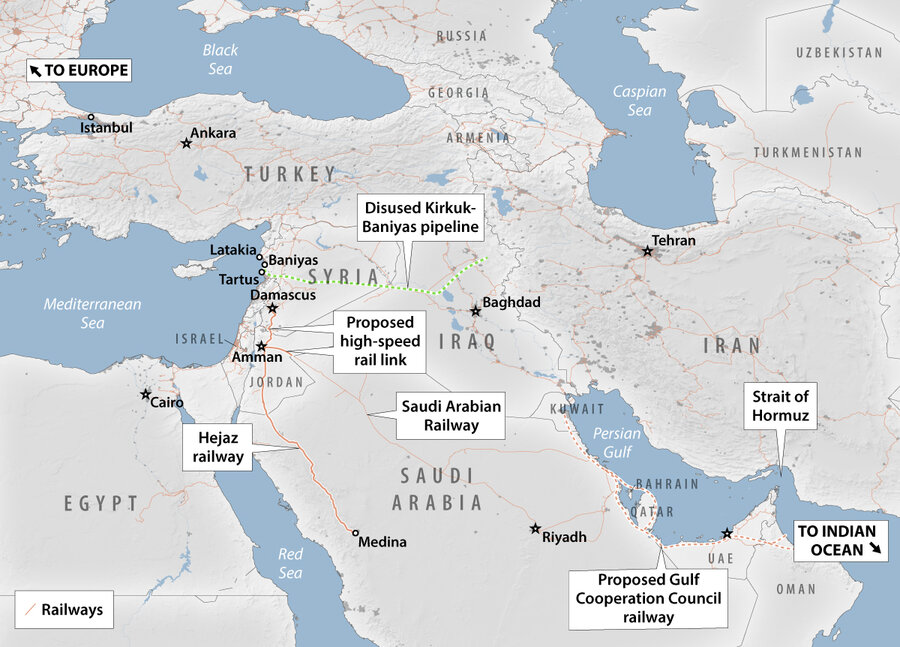
聽Map data from
The track would be designed specifically to link up to the Saudi Arabian Railway, which, as of 2030, is to be connected to the under-construction Gulf Cooperation Council railway linking all six Gulf Arab states鈥� capitals, industrial zones, sea ports, and logistical hubs.
Plans for the new Hejaz coalesced two months after Saudi Arabia announced it was building a line connecting its eastern province 鈥� the center of its oil and petrochemicals production, repeatedly targeted by Iranian missiles and drones 鈥� to Haditha on the Jordan-Syrian border.
If the plans proceed, Syria by 2031 would be at the center of a comprehensive system connecting Europe, Turkey, the Levant, and the Gulf; and the Mediterranean, Red Sea, and Persian Gulf.
Depending on the product being transported or route taken, multiple experts say these connections will reduce four- to five-week maritime journeys to five days or, in some cases, 24 hours.
Gulf Arab officials say they intend to push forward on these new corridors through Syria, even should the Strait of Hormuz reopen today.
鈥淲e will not have our economy and sovereignty held hostage by blackmail from Iran or any other country,鈥� says one senior Gulf official, who was not authorized to speak to the press. 鈥淭he future of our economy and stability hinges on having diverse supply chains to weather instability. Rail and road through Syria is critical to this.鈥�

According to Reuters news agency, the Hormuz closure deprived the global economy of some $50 billion worth of oil in the first 50 days of war. The Gulf economies alone, meanwhile, are estimated to have lost
鈥淭he Syrian corridor effectively functions as a geopolitical insurance policy 鈥� an asset worth investing in even if it is not utilized daily,鈥� notes Yasser al-Mishal, vice dean of the Faculty of Economics at Damascus University.
Obstructions on the line
Connecting Syria with its neighbors is no easy task.
Due to a decade-plus of drug smuggling from Syria 鈥� Captagon, a highly addictive synthetic amphetamine, was a key revenue source for the Assad regime 鈥� Jordan bans the import of many Syrian goods.
Syrian trucks and drivers are consequently not allowed to enter Turkey as well. Instead, they must offload their cargo for Jordanian or Turkish trucks to continue the journey, adding costs and delays.
Competing customs regimes are a red-tape nightmare.
But the steepest hurdle to this new Middle East corridor is the cost.

Syria requires $1 billion to repair existing track and lay new. Only 650 of Syria鈥檚 1,770 miles of track are in service.
It will cost Syria $250 million alone for the 71-mile stretch of high-speed track from Damascus to the Jordanian border 鈥� the key link to the Europe-Turkey-Levant-Gulf corridor.
The World Bank is in talks to provide a $60 million to $200 million grant to help Syria overhaul its rail line, the Transport Ministry says, but Damascus still must make up the difference.
The country already faces up to an estimated $800 billion bill for reconstruction, according to World Bank and U.N. estimates; in 2025, the transitional government spent its entire $3.49 billion in revenue on public sector salaries, education, and health.
鈥�$250 million is a large number today for Syria because there are other priorities,鈥� notes Mr. Badr, the transport minister. 鈥淭here are people living in tents, [and] there is a large number of returnees to Syria who require improved living situations.鈥�
鈥淚t is not acceptable to spend money on [other] things before we house the people ... with dignity, water, electricity, sanitation services, and schools,鈥� he says.
With funding notoriously hard to procure for freight rail projects, the parties should act fast while interest is high, experts say.
鈥淚t is a 鈥榥ow-or-never鈥� inflection point rather than an open-ended opportunity,鈥� warns Dr. Mishal.
Buzz with every boat
There is barely a moment鈥檚 rest at the bustling Tartus Port.
On a recently docked cargo ship, Chinese sailors and a crane operator carefully lower large industrial parts and steel for a project in central Syria.
Each foreign vessel that docks here still brings some excitement to port staff; after years of isolation, another sign that Syria is reconnecting to the world.
鈥淪yria鈥檚 ports and roads are a bridge between continents and countries that is being rediscovered and used as an alternate route, a trend that will continue even after the current crisis,鈥� says Mr. Adra, of the port authority.
Uniformed port workers diligently paint bollards a fresh coat of black, ready for more vessels to come.
As a global logistics hub, they hope Syria鈥檚 ship, or ships, are just coming in.
Walaa Buaidani in Damascus and Baniyas supported reporting for this article.