The Strait of Hormuz: How Iran conflict affects oil tankers – and prices


Half the length of the Chesapeake Bay, the Strait of Hormuz has become the world’s most closely watched waterway in recent days.
Bordered by multiple oil-producing nations, it is one of the most vulnerable chokepoints in the energy trade. Military strikes by the United States and Israel have caused Iran to effectively close the strait to shipping, which generally is governed by international maritime law.
If it remains closed, oil and gas prices are almost certain to surge globally.
Why We Wrote This
Roughly one-fifth of the world’s oil flows through the Strait of Hormuz, and it’s also a key trade route for liquefied natural gas. Our briefing explains what’s at stake for global oil prices as the Iran conflict puts this narrow channel in the spotlight.
Why is the Strait of Hormuz so important?
It’s a roughly 100-mile-long watery connector between the Persian Gulf and the Gulf of Oman, from which ships can ultimately head to the Mediterranean Sea to the west or to Pacific Ocean ports to the east. At its narrowest point, just 21 miles across, the strait’s shipping lanes are so small that tankers are especially vulnerable to attacks.
Oil producers Kuwait, Qatar, and Iran rely entirely on safe passage through the strait to get their exports out. Iraq is almost completely dependent on the strait, as is mega-producer Saudi Arabia (see chart). Roughly flows through Hormuz, according to the U.S. Energy Information Administration. Ditto for liquefied natural gas. Any stoppage, or even a delay, in shipments could send oil prices soaring.

How high can prices go?
It depends on the duration of the stoppage and, ultimately, the outcome of the military conflict between the United States and the Iranian regime. On Monday, oil jumped 7% and by early Tuesday it was trading above $78 a barrel, after spending much of the past year below $70. Just the fear of attack would cause insurance premiums on tankers to surge, adding to the pressure on oil prices.
Prices could soar to “if tanker flows are not quickly restored,� wrote natural resource analytics firm Wood Mackenzie, in a Monday news release.
At a meeting on Sunday, members of OPEC+ agreed to raise production in April by a modest 206,000 barrels per day to keep prices from spiraling out of control. The group includes OPEC plus other oil-producing nations. How much further prices might jump will also depend on Tehran. If it persists in closing the strait, it will also be shutting off its own oil exports, on which the Iranian regime depends.
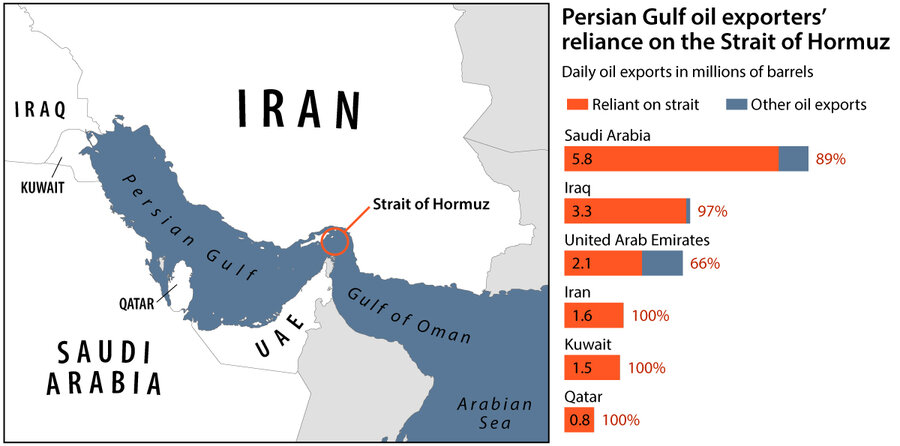
Center for Strategic and International Studies, Vortexa
“Iran is like the scorpion on the frog’s back,� says retired Rear Adm. Mark Montgomery, who is now a senior fellow at the Foundation for Defense of Democracies. “If they close the Strait of Hormuz, they die with the frog.�
Iran could mine the strait, effectively closing the waterway for some time. The U.S. could get its Bahrain-based minesweepers into action, but “this is a weeks-to-months thing, not a days-to-weeks thing,� Admiral Montgomery adds.
Are there alternatives to passing through the strait?
Yes, but they’re limited. Saudi Arabia has Aramco’s East-West Pipeline, a 746-mile, 5 million-barrel-per-day pipeline that bypasses the Strait of Hormuz by carrying crude oil from Saudi Arabia’s Eastern Province to the Red Sea port of Yanbu. But it only has spare capacity of some 2.4 million barrels per day, Clayton Seigle, a senior fellow at the Center for Strategic and International Studies in Washington, estimated in a – before the attacks. That’s less than half its exports.
The United Arab Emirates also has a pipeline that connects to its port on the Gulf of Oman. But it also represents only half its exports, Mr. Seigle writes. With the strait closed, many nations, especially in Asia and Europe, will have to wait for their oil.
Staff writer Anna Mulrine Grobe contributed to this report.