


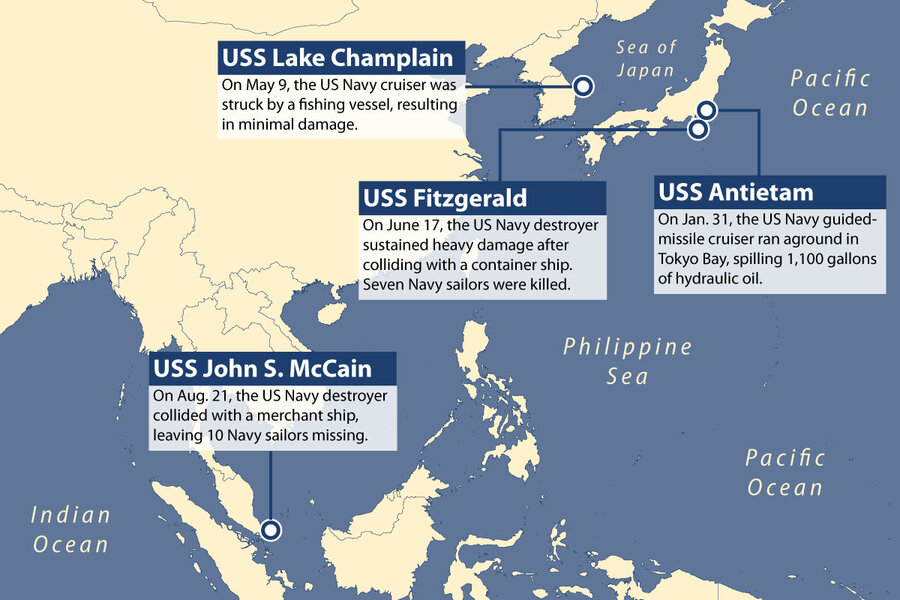
Readiness is a key feature of military effectiveness. Now questions are being raised about whether demands on the service are being properly matched by resources and training.
Our name is about honesty. The Monitor is owned by The First Church of Christ, Scientist, and we鈥檝e always been transparent about that.
The church publishes the Monitor because it sees good journalism as vital to progress in the world. Since 1908, we鈥檝e aimed 鈥渢o injure no man, but to bless all mankind,鈥 as our founder, Mary Baker Eddy, put it.
Here, you鈥檒l find award-winning journalism not driven by commercial influences 鈥 a news organization that takes seriously its mission to uplift the world by seeking solutions and finding reasons for credible hope.
About usAlready a subscriber? Log in
Already have a subscription? Activate it
Join the Monitor community.
SubscribeDoes academia have a choice when it comes to censorship?
Cambridge University Press, which publishes China Quarterly, agreed recently to block 300 of its 鈥渟ensitive鈥 articles in the Chinese market. 聽A CUP official deemed the move 鈥減ragmatic,鈥 as the press faced further action if it did not comply with Beijing鈥檚 request. But others saw a win for China鈥檚 interest in deploying economic clout to silence certain scholarship (think the Tiananmen Square protests).聽
When word got out, academics rushed to remind the world鈥檚 oldest publishing house, an arm of one of the world鈥檚 oldest continuously operating universities, of the perils of ceding to censorship. CUP, which noted 鈥渢he recent increases in requests of this nature,鈥 unblocked the articles this week. China鈥檚 government has not yet responded.
The dust-up involved a small number of articles. But the outcry was rooted in something much larger: increasing pressure from President Xi Jinping to shut down critics and influence the market of ideas at home and abroad. As Chinese students have flocked to Western universities, for example, chapters of the Beijing-linked Chinese Students and Scholars Association have engaged in what some say are campaigns of harassment and censorship on issues that run counter to Beijing鈥檚 agenda.聽
Those pressures will continue to intensify. But as one Australian professor told the Financial Times, 鈥測ou have to stand up for your principles and if that hurts your economic bottom line, then so be it.鈥
Now, to our five stories of the day.聽
Already a subscriber? Log in
Monitor journalism changes lives because we open that too-small box that most people think they live in. We believe news can and should expand a sense of identity and possibility beyond narrow conventional expectations.
Our work isn't possible without your support.
And why we wrote them
( 5 min. read )
Readiness is a key feature of military effectiveness. Now questions are being raised about whether demands on the service are being properly matched by resources and training.

( 5 min. read )
President Trump's hostile attitude toward the media is well known, even if it's intensifying. But his harsh take on key members of his own party has left many people wondering about the path forward.
( 4 min. read )
For leftist leaders who vocally admired the Ch谩vez experiment, pressure is rising to acknowledge the meltdown that has occurred in its wake.
( 6 min. read )
To inform the future, it's important to understand the past. In Rio de Janeiro, there's an app for that 鈥 a techie answer to surfacing a history that has literally been paved over but should not be forgotten.
( 5 min. read )
It doesn't seem to jibe with the "go West" model of American dreaming. But employers seeking fresh talent are finding the pull of home to be a powerful recruiting tool, even in areas where new frontiers aren't immediately obvious.聽
( 3 min. read )
As President Trump launched a 鈥渘ew strategy鈥 in Afghanistan this week, there are signs of progress on an issue he did not target but that is perhaps even more important to Afghanistan鈥檚 future 鈥 the battle to ease the burdens of corruption.
Last week, a highly ranked general and a key businessman 鈥 Gen. Mohammad Moeen Faqir and Abdul Ghafar Dawi 鈥 were tried, convicted, and sentenced in an anticorruption court. 鈥淭hese cases show that money and power are not a guarantee,鈥 Attorney General Farid Hamidi . 鈥淲e still do not have complete justice in Afghanistan, but we no longer have complete impunity.鈥
The burden of corruption on hopes and aspirations can feel heavy indeed. Ill-gotten gains may seem the way of the world. But聽moral courage and truth聽can find space, sometimes where we least expect them. And when they do, history can turn.
Afghan President Ashraf Ghani made anticorruption a priority when he came to office. For instance, he has established anticorruption courts tasked with issues ranging from bribery and tax collection to false licenses and the rights of retirees.
鈥淭his is the most progress they鈥檝e seen in a long time,鈥 says Earl Anthony Wayne, a former deputy ambassador to Afghanistan and global fellow at the Wilson Center in Washington.聽
It became clear early in the 16-year Afghanistan War that rampant corruption in the country significantly affected US efforts to bring stability. President George Bush鈥檚 efforts to stifle the nation鈥檚 drug economy backfired, and President Barack Obama鈥檚 repeated calls on then-President聽Hamid Karzai to crack down on corruption fizzled.
President Trump鈥檚 blueprint for America鈥檚 longest war聽explicitly rejects 鈥渘ation-building鈥 as a goal.聽It involves a mini-surge of US troops, an end to arbitrary time limits for deployment or withdrawal, and a notice to Pakistan that supporting terrorists will no longer be tolerated. But longtime Afghanistan-watchers say that building confidence in government and rule of law can be one of the most effective antiterror strategies.聽
鈥淗elping foster the development of accountable institutions that are responsive to the people and subject to a relatively equitable rule of law is critical,鈥 says Sarah Chayes, senior associate in the Democracy and Rule of Law Program at the Carnegie Endowment for International Peace. 鈥淚nstead, we empowered and reinforced a mafia government, racked by cronyism.鈥 Her book on the costs of corruption, 鈥淭hieves of State,鈥 is based on her 10 years working in Afghanistan, including as an adviser to the US military.
Some of the push for serious anticorruption measures is coming from donors impatient with seeing billions in aid landing in corrupt private hands. But worldwide, a new generation of young people 鈥撀爁rustrated with seeing their futures siphoned to Swiss bank accounts or expensive cars 鈥撀燼re pressuring governments from the street. April鈥檚 anticorruption protests in Romania were organized by high school students. On聽March 26, anticorruption protests broke out in more than 90 Russian cities, with heavy representation among youth.聽A grade-schooler addressed protesters in the Siberian city of Tomsk.
鈥淭hese protests on the street are very helpful, but what is more important is that civil societies develop the technical skills to understand what corruption is 鈥 and convince partners in the private sector that a corruption-free international market is much better for them,鈥 says Peter Eigen, the founder of Transparency International, a leading anticorruption nongovernmental organization.聽
Mr. Eigen, who worked with聽President Ghani on corruption issues at the World Bank in the 1990s, says that Ghani has the background to develop credible institutions and resources to deal with corruption. 聽
鈥淭here is a possibility to change things,鈥 he adds. 鈥淏ut it will take a very strong coalition between a locally based civil society 鈥 not just do-gooders from Germany and the US 鈥 to deal with corruption and lift the standard of integrity. The national government cannot be the leader. It has to be in cooperation with an organized civil society that is becoming stronger and stronger, with more wisdom and more courage.鈥
Each weekday, the Monitor includes one clearly labeled religious article offering spiritual insight on contemporary issues, including the news. The publication 鈥 in its various forms 鈥 is produced for anyone who cares about the progress of the human endeavor around the world and seeks news reported with compassion, intelligence, and an essentially constructive lens. For many, that caring has religious roots. For many, it does not. The Monitor has always embraced both audiences. The Monitor is owned by a church 鈥 The First Church of Christ, Scientist, in Boston 鈥 whose founder was concerned with both the state of the world and the quality of available news.
( 3 min. read )
Sometimes we may find ourselves feeling dislike or even hate for someone. But we are all capable of thinking and acting in accord with what God has created us as 鈥 the reflection of divine Love. 鈥淭he Spirit itself beareth witness with our spirit, that we are the children of God,鈥 the Apostle Paul wrote (Romans 8:16). It鈥檚 not right to tolerate or ignore hate-fueled actions. But recognizing that hatred is inconsistent with this true, spiritual identity can quiet fear, awaken thought to what鈥檚 right, and enable healing and reformation.
Thanks for joining us today. Tomorrow, we'll home in on an eye-catching shift in the Middle East, where聽Saudi Arabia is making a full U-turn and aligning itself with Shiite-dominated Iraq.