You may be asking yourselves the same question we are: How should we evaluate the ferment in the White House? Washington staff writers Peter Grier and Linda Feldmann unpack one piece of that.聽

Our name is about honesty. The Monitor is owned by The First Church of Christ, Scientist, and we鈥檝e always been transparent about that.
The church publishes the Monitor because it sees good journalism as vital to progress in the world. Since 1908, we鈥檝e aimed 鈥渢o injure no man, but to bless all mankind,鈥 as our founder, Mary Baker Eddy, put it.
Here, you鈥檒l find award-winning journalism not driven by commercial influences 鈥 a news organization that takes seriously its mission to uplift the world by seeking solutions and finding reasons for credible hope.
About usAlready a subscriber? Log in
Already have a subscription? Activate it
Join the Monitor community.
SubscribeCivil War history looms large in the United States at the moment. A statue of Confederate Gen. P.G.T. Beauregard was removed from New Orleans streets Tuesday, retreating along with one of Confederate president Jefferson Davis and another commemorating an 1874 insurrection by white supremacists. A downtown tribute to Confederate Gen. Robert E. Lee is slated to join those 鈥 as is a statue of the general in Charlottesville, Va., where protesters last Saturday invoked dark historical precedent by bearing torches.
At the Monitor, we tend to be cautious as we wonder about the forces and precedents shaping the era we ourselves are living through. Such caution is also warranted amid any temptation to think we know how historical figures would weigh in on current developments. Take General Lee, who was invited in 1865 to address a group in Gettysburg. He declined, saying: 鈥淚 think it wisest not to keep open the sores of war, but to follow the example of those nations who endeavored to obliterate the marks of civil strife, and to commit to oblivion the feelings it engendered.鈥
Now let's get to our five stories of the day.
Already a subscriber? Log in
Monitor journalism changes lives because we open that too-small box that most people think they live in. We believe news can and should expand a sense of identity and possibility beyond narrow conventional expectations.
Our work isn't possible without your support.
And why we wrote them
( 5 min. read )
You may be asking yourselves the same question we are: How should we evaluate the ferment in the White House? Washington staff writers Peter Grier and Linda Feldmann unpack one piece of that.聽

( 4 min. read )
Russian alarm is growing over US political turmoil. But any legitimate attempts to calm the roiled waters of Washington are being sharply constrained by US suspicion of聽Russian motives.
( 6 min. read )
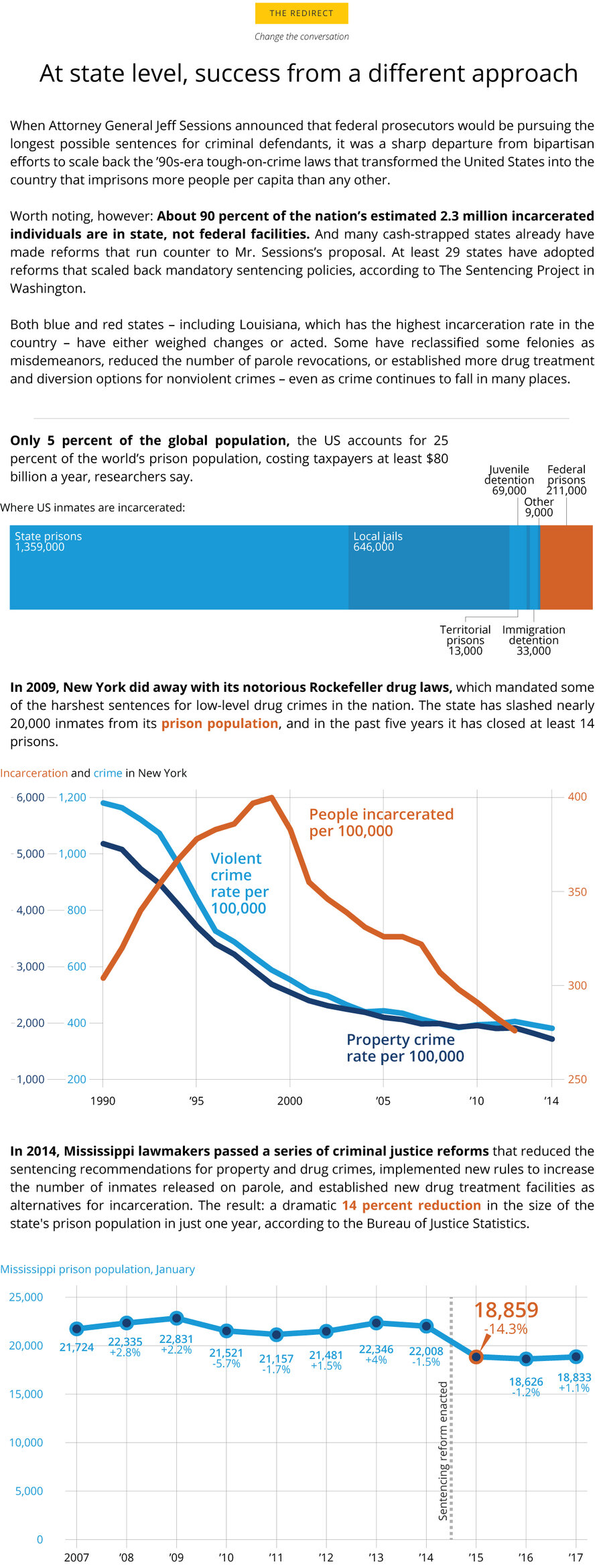
How do you best make the punishment fit the crime? The question features in literature 鈥 think Dostoyevsky 鈥 as well as comic song (see Gilbert and Sullivan). The answer may lie in setting aside conventional notions of 鈥渢ough鈥 and 鈥渟oft,鈥 and looking at what blend of factors is most likely to help criminals set a new course after serving their time.
( 6 min. read )
If America has its 1 percent, Iran has its 4 percent 鈥 the tiny minority that hasn鈥檛 struggled amid decades of sanctions. Presidential candidates are piling on, wooing the 96 percent with a globally familiar populist pitch. But that crowd is savvy: What they want most, they say, is to trust those who aspire to lead them.聽
( 6 min. read )
Large construction firms are accustomed to weighing political and social factors in their work around the globe. But the proposed wall may be pointing to a聽new era of corporate risk.聽
( 2 min. read )
When nations are at odds or even at war, sometimes peace can come quietly through a back door. China and the United States reconciled decades ago through a table tennis match. Serbia and Albania have edged closer after putting on a production of 鈥淩omeo and Juliet.鈥 India and Pakistan have talked of joint research on Himalayan glaciers. South Korea, host of the next Winter Olympics, hopes to welcome a team from North Korea.
The latest example of indirect peacemaking is the opening of the Middle East鈥檚 first scientific research center on May 16. Located in Jordan and nearly a century in the making, it is funded by nine countries in the region, some of which do not officially recognize each other. Yet now scientists from Israel will be working alongside Iranians and Palestinians. And even though Turkey does not recognize the Republic of Cyprus, their researchers will be talking a common language, that of science and math. The other countries are Pakistan, Egypt, Bahrain, and Jordan.
The center鈥檚 focus is a particle accelerator, the only one in the region and a useful tool for peering into molecules in fields from biology to archaeology. Its name is SESAME, an acronym for Synchrotron-light for Experimental Science and Applications in the Middle East. But the name is also the magic password to open a cave full of gold in the fable 鈥淎li Baba and the Forty Thieves.鈥
One model for SESAME is CERN, the large, Swiss-based particle physics laboratory. It was set up after the devastation of World War II to bring together European countries around joint research. This collaboration across boundaries later proved a useful model in other areas of science, such as space exploration.
Science, like the arts and sports, can serve as an ice-breaker and neutral ground for estranged peoples. They require qualities of thought that lift people above national identities or cultural differences. In science, there is an inherent demand for truth, openness, and trust. Researchers often unite in the joy of making discoveries. They later carry back home those moments of unity experienced during mutual learning.
SESAME, while located in the desert and near the war in Syria, is a small bridge between people in the Middle East. Its value goes beyond the science itself, setting yet another example of a cause greater and more lasting than any differences over religion, ideology, or ethnicity. Like the light beams it emits to probe matter, it is a light of hope in a dark corner of the world.
Each weekday, the Monitor includes one clearly labeled religious article offering spiritual insight on contemporary issues, including the news. The publication 鈥 in its various forms 鈥 is produced for anyone who cares about the progress of the human endeavor around the world and seeks news reported with compassion, intelligence, and an essentially constructive lens. For many, that caring has religious roots. For many, it does not. The Monitor has always embraced both audiences. The Monitor is owned by a church 鈥 The First Church of Christ, Scientist, in Boston 鈥 whose founder was concerned with both the state of the world and the quality of available news.
( 3 min. read )
A deeper understanding of Mind brings peace to the disturbed mentality.鈥
That鈥檚 it for today. Thanks for joining us 鈥 and we look forward to having you back tomorrow. We will delve into another question that鈥檚 swirling about Washington: Is it too soon for impeachment talk?