President Trump's decision to share highly classified intelligence with Russia recently has brought up questions about US alliances and聽security. But it has also pointed to something more fundamental: the vital importance of trust in world affairs.
Our name is about honesty. The Monitor is owned by The First Church of Christ, Scientist, and we鈥檝e always been transparent about that.
The church publishes the Monitor because it sees good journalism as vital to progress in the world. Since 1908, we鈥檝e aimed 鈥渢o injure no man, but to bless all mankind,鈥 as our founder, Mary Baker Eddy, put it.
Here, you鈥檒l find award-winning journalism not driven by commercial influences 鈥 a news organization that takes seriously its mission to uplift the world by seeking solutions and finding reasons for credible hope.
Explore values journalism About usAlready a subscriber? Log in
Already have a subscription? Activate it
Join the Monitor community.
Subscribe
Mark Sappenfield
Venezuela absolutely does not want any help. The economy is collapsing and rule of law is under serious threat, but to the government of President Nicol谩s Maduro, accepting any aid is a sign of weakness.
Yet help is coming. Secretly, ingeniously, bit by bit it is getting through. Sometimes sent in mislabeled boxes or hidden in the pouches of diplomatic officials, everything from first-aid kits to baby formula is being brought into the country, according to an Associated Press report. One group has managed to send more than 200 tons of donated items during the past three years.
By necessity, they are small efforts, but they speak to something much bigger. The desire to help others in need cannot simply be shut down 鈥 even when a government might wish it could be.聽
Already a subscriber? Log in
Monitor journalism changes lives because we open that too-small box that most people think they live in. We believe news can and should expand a sense of identity and possibility beyond narrow conventional expectations.
Our work isn't possible without your support.
And why we wrote them
( 5 min. read )
President Trump's decision to share highly classified intelligence with Russia recently has brought up questions about US alliances and聽security. But it has also pointed to something more fundamental: the vital importance of trust in world affairs.
( 5 min. read )
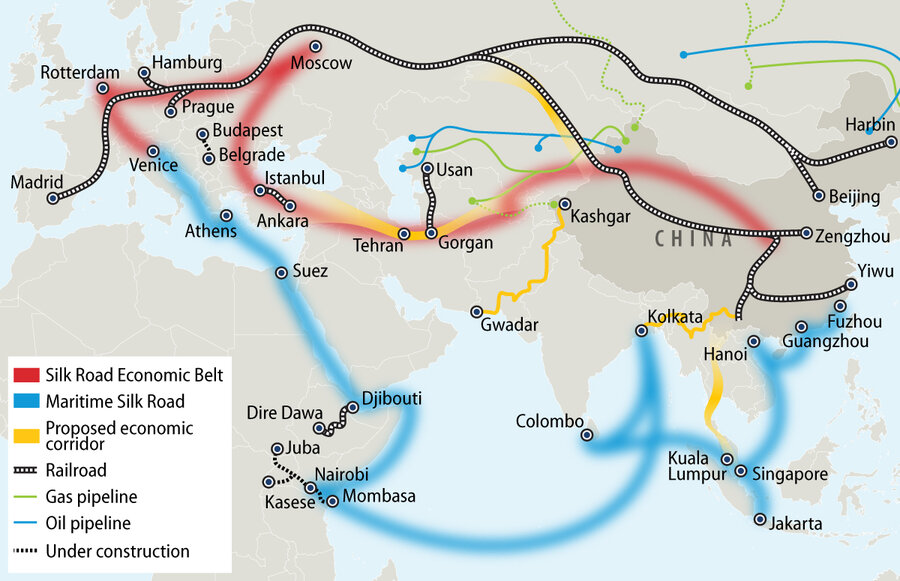
Ideas and influences can spread across the globe in countless ways, from pop culture to military might. China's next big idea for how to connect to the world is actually a very old one: Build a really big road.聽
( 6 min. read )
Germany and France have long made for prickly partners at the center of the European Union. But a change of leadership in France 鈥 and perhaps a change of heart in Germany 鈥 might begin to change that.聽
( 6 min. read )
Indigenous groups have long felt that scientific research hasn't always treated them with respect, at times verging on caricature and exploitation. But a new effort is seeking to find where discovery and dignity intersect. 聽
( 5 min. read )
Making community colleges work is crucial to education. For many Americans, they offer the best promise for a more promising path forward. Now, new research suggests one change could make them work even better.聽
( 2 min. read )
Just days before President Trump鈥檚 trip to the Middle East, which may include a tour of Israel鈥檚 Holocaust museum, his administration has accused Syria of killing thousands of political prisoners 鈥 at a rate of about 50 a day. It even released declassified photographs of the Sednaya military prison outside Damascus, showing a crematorium used to hide the evidence of the slaughter.
Reports of the mass executions at Sednaya are not new. Amnesty International said in February that as many as 13,000 detainees had been hanged there since 2011. But with the State Department now adding to the documented evidence, Mr. Trump has joined a line of recent US presidents who have chosen to deal with a mass atrocity in another country or the imminent threat of one 鈥 from Rwanda in 1994 to Libya in 2011. And like previous administrations, Trump officials have framed the prison killings by the Syrian regime in moral terms, calling them 鈥渁 new level of depravity.鈥
In April, Trump responded to Syria鈥檚 use of chemical weapons on a few dozen civilians with missile strikes on a Syrian military airbase. But how will he respond now that the United States has highlighted the far more systematic and large-scale atrocity at Sednaya?
One goal by the US may be to pressure Russia, a military ally of President Bashar al-Assad, into seeking a peace deal. This would allow the US and its allies to better focus on ending the Islamic State (ISIS) presence in Syria. At some point, Russian President Vladimir Putin may not want to be tainted by Syria鈥檚 slaughter. Or he may not want the US to attack the Assad regime in an attempt to end the prison executions.
US presidents often have to mix a moral purpose with a national interest. Trump is eager to end the threat of ISIS in its ability to inspire terrorist attacks on Americans. But how much is his concern about the prison executions a matter of morality, or simply a tactical move?
President Barack Obama considered the prevention of mass atrocities to be 鈥渁 core national security interest.鈥 Yet despite regular reports of large-scale killings in Syria, he was reluctant to intervene. He had seen how his attacks on Libya to prevent a massacre in the city of Benghazi led to chaos in that country.
Having exposed the Sednaya killings, the Trump administration must now level with Americans about the next course of action. As he heads to Saudi Arabia and Israel, the president should offer clarity about US responsibilities in Syria. The choices are difficult. But a mature debate can help.
Each weekday, the Monitor includes one clearly labeled religious article offering spiritual insight on contemporary issues, including the news. The publication 鈥 in its various forms 鈥 is produced for anyone who cares about the progress of the human endeavor around the world and seeks news reported with compassion, intelligence, and an essentially constructive lens. For many, that caring has religious roots. For many, it does not. The Monitor has always embraced both audiences. The Monitor is owned by a church 鈥 The First Church of Christ, Scientist, in Boston 鈥 whose founder was concerned with both the state of the world and the quality of available news.
( 3 min. read )
A widowed mother in South Africa struggled to provide for her children. But at every turn, they had what they needed, often in unexpected ways.
That鈥檚 a wrap for today. Thanks for reading 鈥 and please come back tomorrow. We鈥檙e working on a story about the best way to fight crime: There鈥檚 a generational divide among prosecutors when it comes to mandatory sentencing.