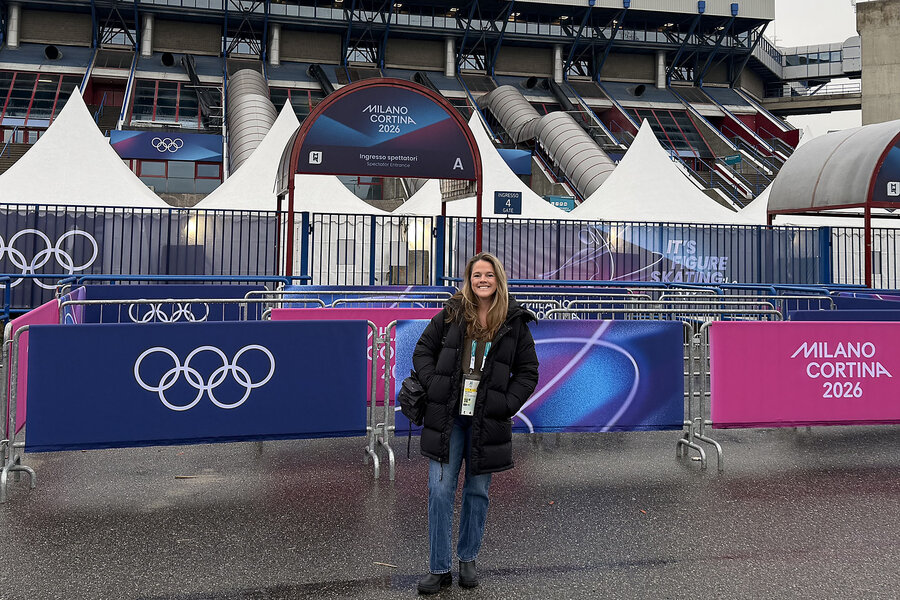
Spectacular finish: A politics writer’s Olympics saga of self discovery
Don’t bother trying to write from a bus that’s doing hairpin turns. Open yourself to the power of human achievement. Adjust to local customs when it comes to how you eat. Pack extra socks. Those were just some of the takeaways for a Washington, D.C., writer turned Olympics correspondent. She joins our podcast to share more.Ìý
Story Hinckley is a reporter who likes a plan. She writes out itineraries – down to the hour – and drafts color-coded schedules to keep everything organized before she hits the road.ÌýBut when criss-crossing Italy to cover the 2026 Milan Cortina Winter Games, sometimes those plans went out the window.
“Every single day has been different,” says Story, reflecting on her rookie experience covering one of the world’s most iconic sporting events.
When it comes to reporting, however, Story is no rookie. She’s covered two presidential campaigns and two midterm elections, and once walked 12,000 steps in one day chasing down lawmakers on Capitol Hill. But add in the snow, as well as the thrill and emotion that come from watching Olympic athletes soar (and sometimes face-plant), covering the Games has been its own unique experience, says Story.
She’s even been tearing up, not something she’s used to as a political reporter.
“It’s really hard not to when you see the vulnerability of these athletes up close. It’s really spectacular, both in glory and defeat,” she says. On our “Why We Wrote This” podcast, Story shares what she experienced covering the Games from the rain-slicked streets of Milan to tiny mountain hamlets in the Alps. And how Italy, as the host country, filled the space between with a lot of warmth and charm.
Show notes
Here's a link to Story's piece on Olympic snowboarders Chloe Kim and Choi Ga-on:
And this piece on Bormio, Italy's Stelvio slope was also discussed:
You can find more of Story's stories – along with coverage from the Monitor’s Mark Sappenfield, who appeared on an earlier episode of “Why We Wrote This” – from the Games on our Olympics page. Learn more about Story on her staff bio page.Ìý
Episode transcript
Kendra Nordin Beato: Covering the 2026 Milan Cortina Winter Olympics, spread across an entire country, has proven to be a logistical feat worthy of a medal. Here to share stories of trains, buses, and one emergency umbrella is Story Hinckley, joining us from Bormio, Italy. Story has been with the Monitor for more than a decade, primarily covering politics, which includes two presidential campaigns and two midterm elections.
But she wanted to try her hand at covering one of the most iconic sporting events: the Winter Games. She’s here to share her thoughts and experiences from her rookie run as an Olympics reporter across Italy.
This is “Why We Wrote This.” I’m Kendra Nordin Beato, guest host of this podcast and the Monitor’s Olympics editor.
Hello, Story. It’s nice to have you with us.
Story Hinckley: Hello.
Nordin Beato: So, Story, what made you want to raise your hand to cover the Olympics for the Monitor?
Hinckley: Well, I’ve always loved reporting from the road on a location. I think it makes writing so much more fun and sometimes easier in a way. You know, when you’re able to really talk about people’s expressions and the smells of the place, and I think probably there’s few reporting opportunities that are as all encompassing and immersive as covering the Olympics.
And I also really like to challenge myself and try new things. Reporting and writing on sports is something I’ve never done before. But, and then also of course, I’ve just always loved watching the Olympics and specifically the Winter Games. Skiing is one of my absolute favorite things in the world. I’ve always preferred the Winter Games because I think there’s something so powerful and special when sport and human endurance is so closely linked to the natural world.
You know, it’s like you’re adding in an additional competitor in a way, right? Like skiing, for example. You’re racing against other skiers to get a faster time, but you’re also racing against conditions, ice ruts, snow –
Nordin Beato: Very tall mountains.
Hinckley: Right, exactly.
Nordin Beato: That’s amazing. Well, as we’ve mentioned, you’ve been covering politics for a while for the Monitor, and you’ve been on this podcast before talking about how you gather your vox pop – which means “voice of the people,” for those who don’t understand that insider language.
Now that you’ve spent a couple weeks chasing after athletes to get quotes and find angles, how is covering politics and sports for the Monitor similar?
Hinckley: Well, I’d say that there’s a lot more...interestingly, there’s more rules with Olympics reporting that I’ve been just learning on the fly. I mean, when I’m reporting on politics, when you see a candidate or someone in power, you run up with your recorder, right? And you throw the recorder in their face, and you elbow through others and you chase after them until they get to a secure location away from reporters.
It’s more of a free for all, and your job as a reporter is to get to them. But at the Olympics, because there [are] financial elements and broadcast deals between NBC and the games, print reporters have to wait to talk to athletes. They have to wait behind ropes until after they’ve gone through the cameras, and then the wire services — there’s a whole system.
And the way that certain reporters have their accreditation, I’m allowed to interview them, but I’m not allowed to film or photograph. So there’s more…in politics, it’s more when you see, you know, someone in power, a candidate, you go get ‘em. But here, here there’s more rules. And of course, I guess because I cover US politics, I haven’t had language barriers as much. You know, I asked the South Korean teenager who won gold halfpipe a question at a press conference…for a quote for a story I was working on. And she answered in Korean, and of course she answered in Korean. She’s South Korean…So, it was still unexpected to me for some silly reason.
So there was no quote. I didn’t use the quote, ‘cause I didn’t know what she was saying and I was on deadline, so I didn’t have time to kind of fully find a way to get the Korean to translate it.
Nordin Beato: Oh, wow. Yeah.
Hinckley: So those are some differences, but I’d say a commonality that I’ve been thinking about the past two weeks is just that in reporting at large, I think it’s far more physical than the average reader would realize. You know, in Washington, when I’m on Capitol Hill, I’m walking sometimes over 12,000 steps just in the Capitol alone, crisscrossing, trying to get senators in between meetings.
“Oh, they’re actually on the other side of the hill.” Fantastic. You know, so you’re running around and then if you’re at a campaign rally, it’s not great conditions. You can be sitting in the hot sun in a hundred degree weather, waiting for it to begin for a long time. And then here I’m waiting at the bottom of a mountain with snow coming in my boots, waiting for athletes to walk by having to be very strategic about when you take your hands out of your mittens. You gotta keep them in your mittens right up until the athlete’s about to come by, so you can take it out and then press record on your recorder. You know, I’m actually hiking up mountains to get to some of these events.
Nordin Beato: So politics kind of prepared you for this two week odyssey across Italy, would you say?
Hinckley: Probably. I would say I’m probably more in the natural elements, probably a bit, but I’ve sat in some bad conditions for campaign rallies, so maybe that readied me a little bit.
Nordin Beato: Right. You’re not trying to hold anybody accountable for their actions like you are with politicians.
Hinckley: Yeah, that’s another difference. I mean, when a politician comes by me, for example, let’s say they’ve lost a race or they’ve just had a bad debate. That’s not my job to feel any type of sympathy. My job is to talk to them and to ask them questions and still have a ruthless reporter aspect about me.
I’m still…obviously, I think you need to bring a human element to your reporting, but I mean, my job is to hold these people who are supposed to represent other people to account. Here it’s different. In the sense that, there was an athlete I really wanted to talk to, and this young teenager, you know, he didn’t do well. You could see him starting to cry, and wanting to get past me to get to his mom.
And I was like, I’m not gonna stop you from getting to your mom.
Nordin Beato: You didn’t wanna pounce on him and demand to know how he was feeling in that moment.
Hinckley: Right. There’s not the same expectation of ruthlessness, I would say.
Nordin Beato: Hmm. Well, some reporters parachute into a place, and they wander around until they run into interesting situations and people. But other reporters like to be a little bit more prepared. Your color-coded spreadsheets are legendary. When you were doing prep work for covering a game spread across Italy, what was your strategy?
Hinckley: Well, I am a big planner regardless. I think everyone close to me professionally and personally knows this about me, but I think that that’s also a requirement for these specific games. You know, five venues across all of northern Italy, you have to bake in travel time if you know to really get good reporting and writing in, you have to have a strategy and a plan. So that introduced my color-coded schedules.
Nordin Beato: Right, which was a life-saver to all of us, you know, following you from Boston.
Hinckley: Yeah. And I think when you’re reporting, I found that it’s really important to let…. The reporting takes you where it will. There’s plenty of reporting trips where I’ve disregarded the schedule that I’ve set out for myself for that day. You know, you meet somebody that has a really interesting perspective and then they say, “well, do you wanna talk to my cousins and friends? They’re having a game night over here tonight.”
And you’re like, “oh, definitely,” and you scratch something you previously planned and that lends to some really great stuff. But I always feel more comfortable going into a reporting trip, when the stakes are high and I wanna produce a good piece of journalism, at least having a plan that I can then scratch later.
Nordin Beato: Right. Well, I hope you don’t mind if I share that you’re also a mom to Hart, who is now how old?
Hinckley: He’s 16 months.
Nordin Beato: And by the time you leave Italy, you’ll have been gone from home for 17 days. I think some listeners might be interested to hear how you as a parent achieve that work life balance. Has it been hard to be disconnected from your family for so long?
Hinckley: Yes. It’s been really hard. I’ll say I’ve been working really hard, and that the days have been really long, and I’m doing really interesting stuff, so it’s not, I haven’t just been totally twiddling my thumbs and, and missing my son, although, you know, I think about him all the time. But I know that he’s really happy and safe and well cared for at home because I have kind of everyone filling in for me at home,
Nordin Beato: With color-coded schedules, I think, right?
Hinckley: They got their own color-coded schedules. Everyone got a copy. Everyone, all the caretakers were different colors, between my mom, my husband, our nanny, and our neighbors, everyone’s a different color. So they and everyone got a calendar. So he is accounted for by the minute.
Nordin Beato: That’s excellent.
Hinckley: He’s having a great time.
I mean, I’ll FaceTime him, and he’ll kiss the phone and then go about his business. He doesn’t care.
Nordin Beato: Right, exactly.
Hinckley: Yeah. He’s having a great time.
Nordin Beato: Oh, and that frees you up then to be like, “OK, I’m just gonna do Olympics for 12 hours a day, every day.” So, tell me, what’s a typical day in the life of an Olympics reporter? Is there a typical day?
Hinckley: There’s not a typical day. Saying it’s 12 hours would probably be on the modest end. You know, “you’re here, so why not just dig in and get as much out of it as you can” has kind of been my perspective on it. I wake up, and again, I’m traveling across Italy to cover these games, so whatever place I’m in that day, I’ll wake up over breakfast. I kind of look at what my day’s going to look like. But again, every single day has been different. I’ll tell you yesterday, again, kind of woke up, regrouped, bundled up in layers. And then this cluster is two cities, Bormio and Livigno, and they’re about an hour and a half by bus in between.
So I knew I wanted to go to the snow park in Livigno to cover the half pipe, so I took the hour and a half bus up there. And each venue has a media center, so it’s basically like a tent, an insulated tent that can either get really, really hot, or really, really cold. And it’s kind of like a big workstation for journalists.
So there’s a bunch of fold-out tables and chargers, some TVs covering different games that are going on. Whatever venue I’m at for the day, I’ll spend some time working on my laptop in the media center, whether it’s setting up a story or sending quotes along, and then obviously running out to catch athletes in the mix zone, which is…they call it the mix zone, I guess, because it’s a mix of athletes and reporters, but that’s where you interview them, kind of at the base of their event space, their mountain or their jump, their halfpipe, and then you take the hour and a half bus back home and —
Nordin Beato: Hopefully find something to eat somewhere along the way.
Hinckley: Hopefully find something to eat along the way. And then it’s probably more writing back in the hotel room, and then you do it all again.
Nordin Beato: Well, I hope listeners go to our Olympics landing page at CSMonitor.com/World/Olympics and check out some of the great reporting you’ve done so far. So much color, so many interesting characters. What has surprised you the most about covering the Olympics?
Hinckley: I think I’m surprised with how emotional I’ve been.
Nordin Beato: Oh, really?
Hinckley: I think I’ve also…speaking of my son, since having a kid, the waterworks start far … easier, but –
Nordin Beato: So much more empathy —
Hinckley: Yeah. So much more empathy.
Nordin Beato: – for the human achievement. Yeah.
Hinckley: You know, I’ll be tearing up for these people. I don’t know, countries that are not my country. Like I just, it’s really hard not when you see the vulnerability of these athletes up close. It’s really spectacular, both in glory and defeat. You know, you see grown men tearing up when they miss a podium by a quarter of a second. I mean, by a length of time that it’s hard to even describe how small it is, and then you know, you see others when they learn that they’ve got the gold falling over in the snow because they, they literally can’t stand up. They’re so excited.
Watching them is really incredible, because I think, you know, as a journalist doing what I love, which is reporting and writing, I get to constantly iterate. I report and I write, I file a story, we publish it. The next day I do it again, right? I get to do what I love – different versions of it. Maybe, you know, that’s not my favorite one. The next day I do it again, but these athletes, you know, they train for every day, for years for this one to two, sometimes one to two seconds.
That’s just been on my mind a lot, how I get, constantly, new chances to be better at my job.
And obviously, they do, too, but their chance to have it on the world stage is far, far more spaced out.
Nordin Beato: So Story, Mark Sappenfield, our Olympics veteran of 20 years, is also in Italy right now, covering the places where you cannot be. What’s it like working alongside someone like Mark?
Hinckley: It’s been really fun watching him cover the Olympics up close. He’s such a veteran at this and he’s so good at it and his instincts with this stuff are really great and it’s just been really fun bouncing ideas off of him and learning from him. In preparing for the Olympics, one of the big things I did in preparation was read through a lot of his past coverage because I think he’s always been such a fantastic Olympics reporter and I just love reading his stuff so much. And so, you know, I would read it and think, try to study it in a way, how can I try to bring my style of writing and my insights to the Olympics, and make it as engaging as Mark does. And a big piece of advice that he’s given me, that I think has been so true, is really be in the moment of the event and trust your instinct about what sounds really interesting to you in the moment. Don’t try to over-think or plan a story angle. If something comes to you in the moment and it feels really interesting, then that’s an idea worth digging in on. And I think that that’s been really helpful as you try to take a bite out of this massive project. It can feel intimidating trying to cover all of the Olympics, but I think that that’s a really great, great piece of advice.
Be where you are in the moment, and look, and if something feels really interesting, really dig in on that.
Nordin Beato: Is that how you came up with your angle for [the story on] Chloe Kim as mentor to these rising stars in the half pipe?
Hinckley: I heard her speak about these younger halfpipe snowboarders before the event. And then as I was watching the event, I was still a little unsure about what direction the story would take. But then at the end of the event, it came down to Chloe Kim’s last run, and she fell, and in that moment the young South Korean snowboarder knew that she had won the gold, and Chloe knew that she had gotten the silver. She snowboarded down the rest of the half pipe, and the very first thing she did was go hug the girl who had just beaten her.
And it really felt authentic; she was smiling so big. She was really happy for her. And I was like, this is the biggest takeaway of the night, from my perspective, is how she has been a legendary halfpipe snowboarder for her entire career. And now there’s all these amazing young girls coming up behind her, and they all say that she’s their mentor, and you could really see that on display.
Nordin Beato: Which is kind of amazing because she could have gotten a third ….
Hinckley: She would’ve made history. Three golds in a row has never been done by anybody, man or a woman in snowboarding. Shaun White has three, but they’re not consecutive Olympics, so she had a chance to really make history. She had a lot on the line. She’d taken a big break. She was coming back after an injury.
It was just really impressive to me. It’s such a level of sportsmanship and respect, and to me, I was like, this has to be the takeaway from the event.
Nordin Beato: Well, one of my favorite stories you did was centered on the culture of winter sports in the mountain town of Bormio, where you are, where the Stelvio slope is located. And for our listeners, that’s the site of some of the Alpine races, and the athletes all talk about the challenge of competing there and how much they love it.
But you found a really interesting man to interview there. Can you tell listeners a little bit about him and how you found him?
Hinckley: Sure. I knew coming into this trip that I wanted to look at the history and the culture of the Italian Alps because these are places where these athletes compete, many of them in their sports every single year. They know these places. I write in the story that Lindsey Vonn talked about how she might not have attempted to come back had it not been in Cortina, ‘cause that’s always been her favorite mountain to race. Like these athletes have real connections to these places. It’s not these brand new manmade slopes that we’ve had for a few of the more recent Winter Games. So I wanted to look at Bormio specifically and this track, the Stelvio slope.
That’s really what the town of Bormio revolves around. It’s a legendary track. The men race here every December. And so, you know, I was thinking, who’s the kind of person that would have a real connection to this track, this slope? And I thought, you know, maybe if there’s a ski instructor, somebody that’s worked on this mountain for a long time.
So I did some research and I found a ski school that’s been around for decades and decades and decades. And so I emailed them, saying, “I’d love to speak with Aldo,” who’s the man that started it.
They said, “yes, he would love to talk to you about the mountain. He does not speak a lick of English, however, so his granddaughter can translate for him. Could you be here by 6?” The Stelvio slope, as I write in my piece, it hangs above the center of Bormio. It goes up high.
These athletes race almost two miles down, so their family lived in the village of Chuk, which is higher up the mountain, right off of this racetrack.
Nordin Beato: OK.
Hinckley: So I said, “OK, but I don’t know how to get to you.” There’s not taxis here, and I don’t even know if there [are] Ubers. And they were … and then they told me, you know, I kind of had to collect from broken English, that there was some type of shuttle.
So I find the shuttle and sure enough, he says, “yes, I can take you there, but I’m not gonna go there for a few hours.”
Nordin Beato: Oh, no.
Hinckley: I say, “Well, OK, well could you go there now?” And he was like, he groans, and then he says, “yes.” So he takes me up there and he drops me on the side of the mountain above the city of Bormio, somewhat in the middle of nowhere.
Nordin Beato: Like just on the side of the road?
Hinckley: Yeah. On the side of the road. And he said, “the hotel ski school you’re trying to get to is around the corner up there. You can walk over there.” So I’m like, OK, well, I’ll trust that. And then I said, “you know, how am I gonna get back down?” And I didn’t really understand with his Italian, I basically communicated with my hands, like, you have to come back for me. I have to make it down this mountain tonight. My hotel is in the city. You have to come back to me please. And he was like, “yeah, yeah, yeah.” I’m like, “No, no, no. Please look … me in the eyes and promise you’ll come back to me.” And he was like, “yes, 7 o’clock, I will come back for you.” I didn’t really trust him and the whole time I’m interviewing Aldo, and learning about the mountain and skiing here in Bormio and the track that he helped design ahead of the World Cup Championship in the ’80s. The whole time I’m thinking I might, I might have to stay here tonight. I don’t know.
I’m going to get back, but then sure enough, I walked down to where he dropped me off at 6:58 and he was waiting.
Nordin Beato: Oh, wow.
Hinckley: I was very grateful and very relieved in the dark.
Nordin Beato: And you were saying that these were some hairpin turns going down the mountainside.
Hinckley: Yeah. This trip has been a lot of hairpin turns on buses. Not for the faint of heart, but daily, I’m going from Borneo to the snow park up in Livigno again, an hour and a half by bus, and it is just hairpin turns up the mountains and so, you know, an hour and a half is a good chunk of time. And I’m trying to write some stories here. So I think I had planned on getting some writing done on these bus rides, which I quickly learned would not happen. I needed to just close my eyes, take deep breaths, let my ears pop and just take a minute before getting there. But yeah, I can cover the halfpipe, let’s say that’s happening between 8 and 10 p.m., but there’s a whole lot of time that goes in on the front and the back end, getting into place and then getting back home, getting to a place where you can write, right?
You can’t write on the side of a snowy mountain, or you can, but you can try to do it on your phone, but your fingers get a little cold.
Nordin Beato: Right? Yes. Yeah, you need that time to transition and then clear your head, put your thoughts down, send them to your editor who’s waiting for you,
Hinckley: Right, and trying to calculate time changes with the editor. And then military time, which is obviously used over here in Italy, but I’m not as familiar with back in the States.
Nordin Beato: Well, you’re doing a fantastic job and we have been thrilled. And as you’ve reported, there are 116 medal events in the Winter Games. Do you have a particular favorite or a new favorite after being there on the slopes?
Hinckley: Well, I knew I would love watching the alpine skiing, the downhill, the Super G, the slalom, because I love skiing. But, I wrote about this: I really have such an affinity for the slopestyle skiers. I was really kind of unfamiliar with it, the sport before this trip, but I mean the things that these men and women do flying off of rails and off of jumps and trying to connect them all to each other…
It’s basically – we say this in the story – it’s a snowy playground that they’re bouncing around on skis, and this is what we wrote the story about. But there’s just so much joy in what they do. They fall, they faceplant, they don’t care. They get back up and they’re like, “where did I face the plant? And do I have time to get enough speed to then go over this next jump and turn three times over myself while twisting two times the other way?”
I mean, they’re just having so much fun. I said this to some of them, “you know, if it was me, and I just faceplanted at the start of my run, I might put my tail between my legs and just ski straight down and be like, ‘I’m done with this.’ But you guys just pick yourselves up and then keep flipping and flying over each other.” and they’re like, “it’s the Olympics. You know, obviously we wanna show the world what we can do. We’re not gonna just stop.”
So that was really cool. I really loved that afternoon.
Nordin Beato: That’s what’s kind of so intriguing and amazing, quite frankly, about the Winter Games, is that you have that sort of carefree attitude of the tricks on the mountains. And as you say, like, “oh, I bobbled. That’s okay. I got another run. Or I’m gonna get up and see if I can make up points with a new trick,” and then you compare it to something like figure skating where if you do a bobble that could just end your Olympic medal hope right then and there.
And it’s just interesting that as you move from event to event, at least watching from home, is just the very different cultures that are around each one of the winter sports.
Hinckley: Totally. I mean, some of these things, again, like you said, these athletes are meticulous in their gear, in what they wear, and you know, when they’re looking at a course – whether it be snowboard, cross or slopestyle, or downhill skiing – the line that they’re gonna take down the mountain, because that could be the difference of a quarter of a second, which again, could be the deciding factor between winning and sixth place. So yes, there is this joyful, carefree energy in many of the sports, but there is also a very detailed, meticulous down-to-the-wire focus in almost all of them.
Nordin Beato: One thing you’ve mentioned is that you’ve really been able to connect with the host country as a place during your trip, rather than being stuck inside the Olympic bubble. What are some of the things you have found particularly delightful or enchanting about Italy?
Hinckley: I understood this a little bit about Italy before my trip, but what I really just found, I found so lovely while being here is that Italians, as it seems to me, are very much in the moment.
People kind of give you a hairy eyeball in many places, many local spots, if you’re just deep on your phone, or you know, you definitely can’t whip out your laptop.
You know, I go to restaurants on the road all the time while I’m on a reporting trip, and I’m pulling out my laptop and writing and working during the meals. Not here. I do not think that would go over well. You very much need to be pausing and in the moment, which I just find really lovely.
Nordin Beato: Well, Italy is one of the food meccas of the world, so I just have to ask you about the food. Have you had it? I know you’re racing from event, to bus, to [your] hotel room, but have you had a chance to enjoy the food? Is there any particular meal that’s standing out to you?
Hinckley: Well, I will say I’ve probably had these, the media centers that I spoke of earlier, they have little food prepared. So I’ve probably – when I’m on deadline – eaten in these little media centers with the food they’ve prepared more often than not.
Here in the Bormio-Livigno region of the Italian Alps, there is a local dish. And I will not try to butcher pronouncing it. It starts with a “p,” it’s a pasta dish. It’s very interesting looking. [Editor’s note: This is probably Pizzoccheri alla Valtellinese.] It’s made with half regular flour, half buckwheat flour, so it’s kind of gray. And the pasta is not the full…it’s kind of the width of a fettuccine, but not as long cut in probably the thirds of a normal length. [It’s] doused in cheese with potatoes. That is the iconic dish of this region. So I did try it. It was very rich; it was good.
Nordin Beato: Sounds like the perfect thing to eat before you ski the slopes, to be honest.
Hinckley: Right. No, I mean, I know why that is an essential dish here. I mean, at my bus stop, there’s locals cross-country skiing around in circles in the park behind my bus stop here.
Nordin Beato: I love that.
Hinckley: And then they go have their buckwheat pasta with potatoes!
Nordin Beato: Right? Well, now that you’re officially an Olympics veteran reporter, what are some things you wish you had known before you packed your bags?
Hinckley: Well, in the packing of the bags, I wish I had packed more socks because I’m wearing snow boots every day. The sneaker socks that I packed are really … I wish I’d packed more pairs of boots socks, because you go through them pretty quickly.
I kind of love that I came into this not really knowing much about reporting at the Olympics, or really knowing much about many of the sports themselves. Like I wake up in the morning, you know what? Let’s become an expert in snowboard cross.
And then you learn, whoa, they do it in six heats. There’s colored jerseys. That’s a foul. It’s just fascinating to learn the intricacies of all of these sports, you know. In the halfpipe last night, it’s not just how cool the trick looks, the height they go in the air matters also. They have to grab their board on every single jump. Just learning the details about all of these sports that I have to say I really, really knew probably nothing about has been so fascinating.
I’ve really loved it.
Nordin Beato: Mm. Well, reflecting back on your Olympics reporting, do you have a favorite moment that you’re gonna carry home with you?
Hinckley: I think I’m definitely gonna look back on these games really happy and proud of how much work I put into covering them, and also how I tried to immerse myself in the experience. “You know, OK. This region has a kind of strange sounding local pasta dish. Let’s try it.”
Nordin Beato: Yes.
Hinckley: “This event you’re gonna have to spend maybe 45 minutes reading about the really detailed rules of how the quarterfinals are decided in this specific sport. Let’s do it.”
I think I’ll definitely look back fondly of how I was really able to immerse myself in this experience. Kind of have blinders on and just be all in on the Olympics for 17 days.
Nordin Beato: Amazing, Story. You have taken us with you to the height of the Alps, and we’re so grateful to you. We hope your trip home goes smoothly and you have many clean socks and baby hugs waiting for you when you get there.
Hinckley: Thank you.
Nordin Beato: And thanks to our listeners. Find links to some of the stories you heard discussed in our episode show notes at CSMonitor.com/WhyWeWroteThis. For all of our Olympics coverage, visit . This episode was hosted by me, Kendra Nordin Beato, and produced by Mackenzie Farkus. Jingnan Peng is also a producer on this show. Our sound engineers were Alyssa Britton and Ian Case. Original music by Noel Flatt, produced by º£½ǴóÉñ. Copyright 2026.