‘Like coming home’: Thrilling feats and inspiring stories at another Winter Games
Our global correspondent loves sports. And he loves snow. So he lights out for the Winter Olympics, icy pinnacle of international athletics, every chance he gets. Just ahead of his current trip to cover the 2026 Milan Cortina Games, he joined our “Why We Wrote This” podcast to break down his thoughts about, and plans for, one of journalism’s great recurring events.Ìý
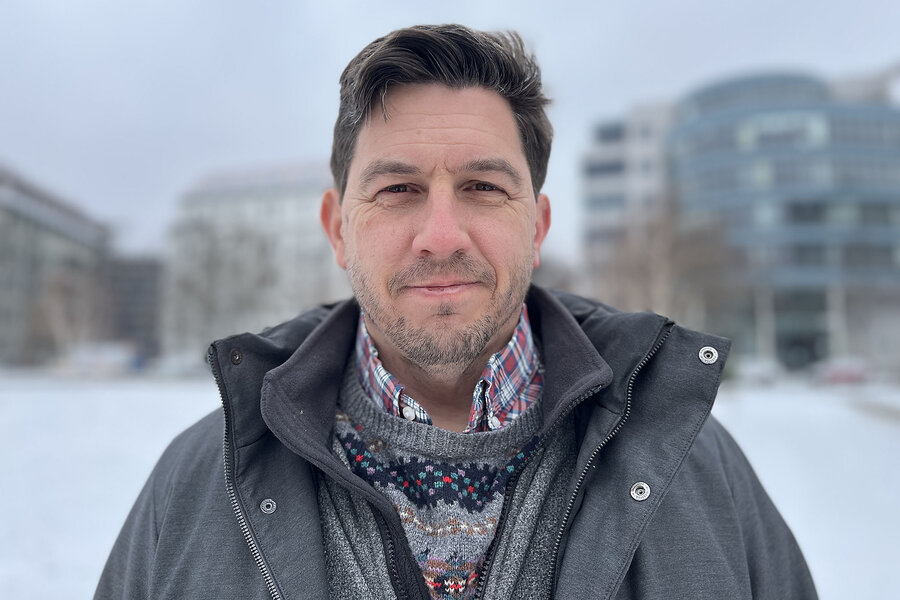
Mark Sappenfield rarely gets bothered by the cold. That’s a good thing for a reporter who is covering his fifth Winter Games for the Monitor at the 2026 Milan Cortina Olympics. Growing up in Michigan, he simply always expected to have snow on the ground from Thanksgiving to April.
“There’s something just kind of like coming home when you go to the Winter Olympics,” says Mark, who has also covered three Summer Games. He never tires of what he calls “a festival of sports.”
“When the Olympics are right, when they hit the right note … there’s just nothing like it,” he says. “There’s something to the Olympics that’s unique. ... There’s a sense of genuine fellowship … reflected in the host cities when they really take that spirit themselves.”
Mark strives to find a unique angle when covering the Games. There are, after all, 3,000 other accredited journalists trying to do the same thing. For him, it comes through observation and his own experiences rink-side and slope-side watching events.ÌýOn our “Why We Wrote This” podcast, Mark shares why he loves the unpredictability, creativity, and risk of the Winter Games.
“For someone who really loves both sports and also the inspiration that sports inspire,” he says, “it’s fantastic.”
Show notes
This is the essay on which much of this podcast interview was based.Ìý
You can find more of Mark’s stories – along with coverage from the Monitor’s Story Hinckley, who will appear on a later episode of “Why We Wrote This” – from the Games on our Olympics page. Learn more about Mark on his staff bio page.Ìý
Episode transcript
Kendra Nordin Beato: It’s been just over a century since the first Winter Olympics brought 16 nations together in the French Alps in 1924. The gutsy and artistic feats of those early competitors introduced winter sports to the masses, inspiring generations of athletes to strap on skates, skis, and launch sleds down icy slopes.
Mark Sappenfield, the Monitor’s global correspondent, has had a front row seat at seven Olympics. Those include four winter Games in Salt Lake City, Turin, Vancouver, and Sochi. He returns this year with our reporter Story Hinckley to cover the 2026 Milan Cortina winter Games. The winter Games are also Mark’s favorite Olympics.
He recently wrote an essay for the Monitor titled “Why I Love the Winter Olympics.” He’s here with us today to share his thoughts.
[MUSIC]
Nordin Beato: This is “Why We Wrote This.” I’m Kendra Nordin Beato, guest host of this podcast and the Monitor’s Olympics editor. Mark, it’s nice to have you with us.
Mark Sappenfield: It’s good to be here.
Nordin Beato: So Mark, what is it about Olympic events held across land of ice and now that to you feels more appealing or dramatic than the summer Games.
Sappenfield: Well, part of it that I didn’t get in that article is that, I just grew up in a place in northern Michigan where you got lake-effect snow. I was like in middle school before I realized that it wasn’t normal for every place on earth to have snow from Thanksgiving until April. I just thought that’s what winter was. You know you watch Charlie Brown, and there’s snow. And you watch all these things, and there’s snow. And so it was like … yeah, there’s just snow, and there’s lots of snow. So that’s just kind of the natural state for me, is to see snow. And so there’s something just kind of like coming home when you go to the Winter Olympics, because it has snow, or usually it has snow. You know, the Summer Olympics, I’ve been to three Summer Olympics, and they’re fantastic. They’re amazing. So comparing them is kind of like apples and oranges. But you do get in the Winter Olympics absolute craziness. And that’s something that you maybe get a little bit, they’ve started to try and add a little bit to the summer Games, you know, with the BMX, and then they had the break dancing and things like that. They’re trying to add a little bit of that X Games feel to it.
But to be honest, that really, I mean, it started originally, you know, when you’re doing ski jumping, that’s crazy. And that’s been happening ever since the Winter Olympics almost started.
But then they’ve really leaned into it with all the snowboarding events and all the, you know, free skiing events, and adding skeleton, and, you know, all these different things. They’re the danger games. There’s just an element of like, Oh my gosh, I can’t believe a human is attempting that.
Nordin Beato: OK, as someone who loves the summer Games, I’m gonna push back just a little bit here. What about gymnastics? I mean, look at Simone Biles, who generates mind-dizzying height and complicated twists in bare feet.
Sappenfield: Yeah, exactly. You know, it’s not like you have to say one is better than the other. You know, you think of who’s the greatest football player ever, and you can say it’s this or this. But the fact is they’re all great. And, you know, I love going to the Summer Olympics, too. You know, the difference is that when you do the Winter Olympics, you start getting things strapped onto humans that make them do things that make them even more crazy. So Simone Biles going and running down the mat the way she does and doing all the flips is phenomenal. But then you put ice skates on someone, and you’re going twice as fast. You put skis on someone and they’re going four times as fast. And it’s just, it’s pushing the boundaries. It really just kind of amps up the difficulty level in ways that, I think it comes across on TV, but I think when you see it in person, just the sensory experience.
You know, I wish people could hear a bobsled run. A bobsled run is just this concussive thing, actually quite terrifying. If you’re standing next to the track, when the sled goes by, you feel it reverberating through your body, and it’s this deep, guttural crunching, like, holy moly, you know, people are just going down that thing, and there’s a lot of force behind that. But even when you talk about Alpine skiing, there’s this kind of crunching, crackling, kind of scrappy sound that, it’s just like, these people are just hanging on by their toenails to do these things, and they’re doing it at 80 miles an hour. And you just, being there in person, it’s quite awe-inspiring.
Nordin Beato: I love that. I mean, in your essay, “Why I love the Winter Olympics,” you have this great turn of phrase, “a teeth-chattering, bone-rattling infusion of rocket fuel.” And I really want to encourage listeners to find and read your essay on our website because it’s full of delightful turns of phrase like that. So thank you, Mark, for putting readers right at rinkside, slopeside. And it’s really true, I mean, anyone, an average human who has tried to strap on skis and ski down a slope, the very first time it’s very terrifying. So I can’t imagine what it feels like at 80 miles an hour.
Sappenfield: Yeah. And growing up skiing, and I did a little bit of very basic ski racing, like when I was, late elementary school, but you know, like for a season or two, nothing serious. And I would go skiing for the rest of my life. But the way these people go down that run … and of course you can see it, cause you’re watching it, but just going, especially the downhill, the super G, the speed events, like, the amount of strength that it takes to be able to hold that line is just unbelievable. And I think that’s one of the reasons it’s so hard for the Winter Olympics, is because lots of people don’t do these things. So, you know, I did alpine skiing. So when I watch that I can look at it and have a real appreciation for it. You know for a lot of people, these things are very foreign.
So I feel like, thank you for what you said, Kendra. I think part of my job is to try and make it relatable, make it understandable. You know people can understand a hundred meter dash. People can understand a long jump. Even a pole vault, which is a little bit weird, you can still get the idea. You know, when you’re talking about the luge, OK, yes, we all had, you know, many of us had a sled and we went down there, but it’s kind of a whole different ball of wax. And it’s interesting, it’s fun to try and really inhabit that space and try and bring it across in a really visceral kind of way.
Nordin Beato: Yeah. Well, you talk about growing up in a snowy place, and I certainly relate, having grown up in Wisconsin and New Hampshire. And small fact aside, Eric Heiden and Beth Heiden went to my elementary school. I was, you know.
Sappenfield: You taught them everything they knew, right?
Nordin Beato: No we were the little kids getting their autographs, but their quads were ginormous.
Sappenfield: Yes.
Nordin Beato: But anyway, so, you know, you grew up in a snowy place. As a reporter, how do you survive the assault of the physical elements of winter as you’re trying to chase down these athletes, and get a quote after they’ve completed a run or a performance?
Sappenfield: For me it’s not hard, because since I grew up in cold and snow, it’s just, it’s cold, wear more clothes, sort of thing. So, you know, you helped me on this story that we’re talking about, a separate story that was the cover story, it was an icy sheet, and you had to put on crampons.
Nordin Beato: Yes.
Sappenfield: So sometimes you have to do that stuff. But I think it speaks to this kind of adventure. There’s a sense of adventure in the winter Games that, as wonderful as the summer games are, they just can’t quite do [it] in the same way. And you know, the idea of having to navigate icy slopes even as a journalist, you know, it’s just kind of fun. You know, it feels like you’re doing something, as opposed to just you know walking down an asphalt street.
Nordin Beato: Right? You’re being an athlete yourself. I mean, a little bit.
Sappenfield: A little bit, yes, in a very small way.
Nordin Beato: Well, yeah, except for, the difference is you have to stand around a lot. You know, it’s not like you get the benefits of moving or wearing skis. That was, my shocking discovery was riding the ski lift up without skis.
Sappenfield: It’s a weird sensation, isn’t it?
Nordin Beato: Very vulnerable. Yeah, it was very funny.
Sappenfield: Yeah, so I mean, you know, you get the hand warmers, and you figure it out.
Nordin Beato: OK, well, there are 3,000 accredited journalists covering the Milan Cortina Games, not to mention the new kids on the media block, the social media influencers.
Sappenfield: Mm-hmm. I have seen them.
Nordin Beato: Oh, yeah?
Sappenfield: They’re easy to spot. They’re totally doing a different game. Like, you’re over there doing it. They’re like taking selfies and like asking them these really weird questions. You’re like, yep, they’re doing a different thing than I am. But more power to them. I’m sure a ton of people watch them.
Nordin Beato: Yes, all the TikTok hits, everything. But OK, so how do you handle the big stories that everyone else will be covering, such as Maxim Naumov, the American figure skater who lost his parents in a plane crash, or the hopeful return of Alpine racer Lindsey Vonn [she would crash out of the Games on Feb. 8, 13.4 seconds into the downhill final]? How does looking for the Monitor angle help you identify stories that may be overlooked?
Sappenfield: I mean, on some level, we’re all partial to the work that we do. So there’s one part of me that just hopes that, you know, we are all different, so if you see, if you give a little bit of the sense of how things look through your eyes, hopefully you give us slightly different flavoring of what’s going on than someone else. And that’s good. You know, there’s a really good reporter, he used to be for The Wall Street Journal. He might be for The Athletic now. I don’t know. But I always read his stuff. I’ve met him before. And you can just kind of see him in his stories. And that means they’ll be a little different from mine. And I loved them. But hopefully I can add that same kind of flavoring too.
But I do think that covering it for the Monitor, I think sometimes the humanity at the games can become a little bit saccharine and a little bit formulaic. The struggling athlete overcoming all these things – and that is 100% true. But I think there’s a way of trying to get beneath that to the actual emotions of the person. And the only way you can really do that is by observing them. And obviously someone like NBC, they have much much much more access than we do. Generally I don’t get access to individual athletes at all. I’m watching them as other people are interviewing them, but that’s a lot of what I’ll do.
So they have this thing after, it could be after a race, it could be after a heat, it’s called the mixed zone, and what it means is, and you know this, Kendra, because you saw it when you went to the thing that you did recently, is that they finish their run, their heat, whatever, and then they have to kind of walk through a labyrinth. It’s usually kind of laid out like a maze, and they have to walk through it, and at each corner of the maze, there’s a different place so you can get… The visual media, NBC always goes first, and I’m not kidding, like literally because they’ve paid so much money. In the mixed zone, NBC is always first. And basically, NBC talks their heads off. So by the time they’re finished with NBC, then they just want to get through the rest of the mix zone. But these are people who really want to promote their sports too. So they’re generally very generous with their time, and they recognize it’s in their own best interests to stop and talk to people. And they will, most of them, not all.
But by the time they get to the [print] press journalists, they’ve already gone through a bunch of people because the TV people always come first. But oftentimes, what will happen is all the media people, the press people for the newspapers, will all crowd up against the fence, and they’ll lean in toward them, and they will all stick their microphones in their faces. And obviously for microphones, it’s recording equipment. It’s not actually recording it for a TV thing, because that came earlier. And they’ll all try and elbow in their question. It’s a classic, what you would imagine journalists to look like.
Nordin Beato: Like a mosh pit.
Sappenfield: Exactly. I look at it and cringe a little bit, like, “Oh my gosh, I’m a part of this.” What I generally do is, I’m tall, which helps, I’ll just kind of hang back a little and watch. And I watch how they react. I listen to how they’re answering a question with what tone of voice. Are they being patient? Are they impatient? How does that reflect on the run? Because in the Olympics, you just won the gold medal, how are you handling that? You just didn’t win the gold medal, how are you handling that?
Nordin Beato: Yeah.
Sappenfield: And I try to be an observer. And then if you do a lot of reading, too, you can begin to knit together deeper parts of the story. And, you know, I probably don’t have the access to do it to the level that some others do. But I feel like I can add something from my own experiences. And, one person I particularly followed a lot, because I found her very, very interesting, again, being an alpine skier, is Mikaela Shiffrin. I went to several media events where she was. I would just hang around in the vicinity and just watch her. And what I always appreciated is that she’s such a technician. She’s very scientific about how she approaches her sport. And it was just interesting to see how that came through and how she dealt with the media. And so in Sochi, that was her first Olympics, some of the stories I wrote were about watching her and how she expressed herself in this very, I mean, very scientific way, even when talking with journalists. She always wanted to take things in and analyze them. Which is very much when you read stories about her, you know, who she is. So I mean, I think you can mash all that together and get a picture that hopefully, if not unique, then gives a different flavor than you get with the 3,000 other journalists doing it.
Nordin Beato: You were talking about tricks, so let’s talk about tricks. The freestyle skiers and snowboarders on the half pipe are masters of innovation, always looking for ways to up their tricks, like the triple cork 1440. And for listeners at home, that’s snowboard speak for launching off a 22-foot-high half pipe followed by four flips and four full rotations. What about skating? Are we at the edge of what can be done in the rink? I mean, the half pipe, I imagine, it can always get creative, but you can only get so high above the ice.
Sappenfield: You know, you want to say yes, because the hardest jump in skating is called the axel. And the reason it’s hard is that you take off going forward and you land going backwards. So it means a triple axel is actually three and a half rotations. There are three other jumps. And those are all, you start going backward and you’ll land going backward. So those are three rotations. Axel is three and half. And you’ve got people doing triple axels, you have people doing quads, and you just are like. How can they keep going on this? So I mean, you’d think that they are reaching the level of it, but we’ve thought that before. And so I think someone’s gonna hit a quint, at some point, you know, five rotations. It sounds crazy, but there’s just so much in sports that we thought was impossible that turns out not to be. Now, could you actually do six rotations? I think at some point, you’re saying, yeah, we’re done. We can’t keep going. But I’d be loath to say there’s nothing ahead. It feels to me like there might be a little bit more space to push into. We’ll see.
Nordin Beato: OK, well, we’re talking about creativity, and quite frankly, a lot of the risk the winter athletes infuse into their sports. So let’s go bonkers for a minute and imagine the Winter Olympics 25 years from now. What might that look like? I mean, this year we’ve got the new sport of mountaineering.
Sappenfield: Yeah, ski mountaineering.
Nordin Beato: What else, you know, what’s something new that we might see, based on the creativity and the risk that is so common to the winter Games?
Sappenfield: Well, I think, you know, you talked about just being able to constantly ramp up tricks. The other big event for that is called the big air. And, you know, that is with the half pipe, you obviously go down a half pipe, and you go up, and you do generally three to four tricks when you’re going down the half pipe. The big air is literally just one gigantic trick. You go off, not quite like a ski jump, but similar. And there, I think, the most recent one, I think, was a 2340.
And you know, I think there will continue to be that. I think you also get people doing these tricks more smoothly and more elegantly. You know, if you go back to when some of these tricks were originally being done, you know, it looks like they were just hanging on by their toenails to do these things, but now they’re doing them relatively easily.
Nordin Beato: Or even early ski jumping, early videos of ski jumping. You talk about in your essay the agony of defeat.
Sappenfield: No, and it does. It looks like they were playing with chopsticks back then. It’s like they jump and it’s like, they go three feet. And like, oh, that’s what it looks like. Whereas now it’s so powerful. But I think that’s inevitable. And I think that will always happen. I think one of the things that Story Hinckley and I, the person who’s doing this along with me, have talked about is that there’s always this balance between artistry and athleticism. And that’s something that’s really big in gymnastics, too, as you talked about in the Summer Games.
The Olympics have very much recently – really since Salt Lake, when there was the Salt Lake judging scandal — have really tried to emphasize athleticism over artistry, because athleticism is ultimately what it’s about a sport. You can also judge athleticism much better than you could judge artistry because artistry tends to be. You know, you just notice a very great difference in how people view it between Russians and Americans in figure skating, for example. You know they just value different things and so you can look at the Russians say, oh they’re biased but they just see it differently. They see artistry differently. And so the Olympics have gone much more toward athleticism and you see that exactly with what we’re talking about in figure skating. Figure skating has gone away from artistry and more towards doing tricks that can be judged much more easily and, one would say, fairly.
But you do wonder is as you start getting toward the limits of these things, you do wonder if there’s gonna be a push back toward artistry because if you really can’t do a quadruple axle, if it’s just not possible, then it’s like, how cleanly can you do the best jump? So you’re doing a bunch of quads, everyone starts doing a punch of quods, but it’s how cleanly do you land it? What’s the speed on entering it? I don’t know, but I could imagine that you could see kind of a little bit of a return to artistry. Because that’s what’s gonna, these fine margins, that’s where it’s gonna distinguish those two. And the other thing that you see, somewhat in the Summer Games, but again, more in the Olympics, is the importance of equipment. And I don’t know if you remember this, but maybe 12, 16 years ago, they invented the clap skate, which is something when you’re doing the long track speed skating, not the short track, but the long track. It was something where the back had a hinge on it, so the actual skate was not attached to the back in the way it was saying it was to the front, and it kept the. The blade on the ice fractionally longer which gave you a little bit more push, and that revolutionized times, like world records just fell after that.
And so you can imagine, can there be, and obviously the sports have to agree to this, but could there be some technological developments in figure skating that change the nature of the skates that give you more width, that allow you more jump? I don’t know, but people are always looking for that little bit extra. And I can imagine technology might be where you find some of those fine margins as kind of those limits of human ability get reached.
Nordin Beato: Right. Well, let’s talk about one of the events that requires peak physical conditioning…
Sappenfield: Curling!
Nordin Beato: Yes!
Sappenfield: I knew it.
Nordin Beato: All right, in your column, you poke fun at curling. Like, who even cares about this sport, where people furiously sweep....
Sappenfield: Right, but it was from love! I’m playing it up.
Nordin Beato: OK, but in 2010, you wrote an explainer from Vancouver about curling and that story still gets tons of online views every time the Winter Olympics rolls around. What’s so fascinating about curling?
Sappenfield: Well, I think it’s just, it’s on and people don’t know what it is. And so they turn it on.
Nordin Beato: [Laughs.] So it’s like curiosity. It’s like, “well, what am I seeing?”
Sappenfield: If you have Peacock, which is the streaming service in the United States that does this, they have a channel that probably just does curling all the time. So you’re flipping through and you’re watching curling and you’re like, “what is going on here?” And so you Google, “what is curling?” And I think just knowing how these things work, it tends to be a viral sort of thing that once something gains some momentum, then it’s like a tumbling stone down the hill that gains more. And so I think my story probably got some initial momentum because I did have fun with it. The whole idea was to kind of pretend that here you are, this kind of ignorant person who’s just tuning in going, “what the heck is going on?” And I just kind of went with that and had fun with that. But I mean, it’s the idea of trying to explain what they’re talking about.
And I lived in India for a while and watched cricket. And cricket is a sport where it has its own language. Literally if you come in and watch a cricket match, you have no idea what they’re talking about. They could be talking in a completely different language. And curling has a little bit of that; there are just these terms that if you don’t know what they’re talking about, it’s completely mystifying so you do have to not only understand what they are doing, you have to understand the words that they use when they talk about it. So there’s a lot of de-densifying to do, and you know the goal was to do that in a way it was entertaining and not just, you know. Here are the rules of curling. The house means, you know, the button. What is the button? What is a draw? What is the hammer? You know, how do you do that in an entertaining way?
Nordin Beato: Have you been to many Olympic curling matches?
Sappenfield: Not a ton. The one that I did from Vancouver, I think I was at that match. They all blur together now, but I think was at the match and that’s why I did that.
Nordin Beato: And what is it like seeing it in person? Is it like watching paint dry? I don’t know. I mean, you’re what? It’s like pool, but then there’s a broom and ….
Sappenfield: First of all, all the teams are playing at the same time. So you’ve got a sheet of about five or six different sheets right next to each other, and they’re all playing at the same time, so it’s a question of which one you want to look at. And there are obviously fans that are watching different ones, so fans will cheer, and if you’re watching a different one, you’re like, why are they cheering? And it’s because something happened on the other one. And so there’s some, there’s a little bit of that when you’re watching it in person, and I guess for the final it wouldn’t be the case, but this is for the kind of preliminary rounds. There’s a little bit of that kind of split-screen TV, which is you can kind of flip channels, and it’s like, I’m gonna watch sheet one, or sheet two, or sheet three. It’s fun when you can hear the crowd really starting to get excited about something, and you switch over and you kind of watch that one. I mean, with all these Olympic sports, there’s something communal about it.
And a lot of the people who go to watch, yes, there are just people who are from the local area who probably don’t know a lot about that sport. They’re just there to get kind of the Olympic thing. But there’s always people there who are family and friends, and there are always people that have traveled there for that. And if you kind of dial into those people, that’s very infectious in a good way is that you can kind of there’s always a core of people who cared passionately about it and know what’s going on and you can ride those coattails and get kind of in on that.
Nordin Beato: Reflecting back on your more than 20 years of Olympics reporting, do you have a favorite moment that stands out to you?
Sappenfield: I suppose, you know, there are ones from just things that I enjoyed because I enjoy alpine skiing. I became a huge Bode Miller fanboy just because the way he skis is crazy – or he did ski, when he did it. And I remember watching him in an event where he literally fell in the middle of the run, got up, kept going and then ended up getting a silver, I think.
Nordin Beato: Wow. Or he finished one run and one ski, I think, right?
Sappenfield: That was not in the Olympics. But yes, that was a very famous downhill where he lost his ski halfway down and just kept going. And it’s like that became an incredible video. And everyone who knew skiing loved him after that, because that was just like such an insane thing. He actually went into a tuck at one point, which is just like so Bode Miller. And then, you know, Mikaela Shiffrin is the opposite. And I mean, they both are technicians, just in completely different ways. So seeing her win gold was great. But I think, to me, what has stood out the most is when the host cities really get into it. And I just remember walking the streets of Vancouver and just thinking these people are loving it.
Nordin Beato: Hmm.
Sappenfield: When the Olympics are right, when they hit the right note, I’ve covered a fair amount of sports and there’s just nothing like it. And you know, that again, sounds very cliche, you know, the Olympic spirit, but it’s true. There’s something to the Olympics that’s unique and there is a sense of legitimate camaraderie. There’s a sense of genuine fellowship that happens at the Olympics that you see in the sports but is reflected in the host cities when they really take that spirit themselves. You saw that in Salt Lake, but I guess the one where I felt it the most was in Vancouver, because Vancouver was fairly warm weather. They had the Alpine up at Whistler, but within Vancouver, it was probably 40, 50 degrees. So it wasn’t that. So people were out on the streets. There was this kind of street life that was happening there. And especially, you really remember after Canada won the gold medal in the hockey match, they were just so excited. And it was just fun. There was something vicarious about just kind of riding along that wave and just enjoying the moments that I don’t think I’ll ever forget.
Nordin Beato: Oh, I love that. Well, what are you looking forward to at the Milan Cortina Games?
Sappenfield: You know, I think it’s just all of it. And now, unfortunately, with the way the Winter Olympics are going, they’re getting more and more spread out. I remember that my first Olympics in Salt Lake City, pretty much all the venues were within 45 minutes of one another. Now you’ve got some venues that are five and a half hours away, so you just can’t cover the whole Olympics. But I mean, Salt Lake, Turin, even Sochi, it’s like sports tourism. You know it’s like you get to do curling in the morning and ice hockey in the afternoon, and then speed skating in the evening. It is literally a festival of sports. And for someone who really loves both sports and also the inspiration that sports inspire, to be redundant, it’s fantastic. And I think just being there and soaking it up, and being able to see the diversity of what goes on, you know, I’ll, I’m going to be at Milan to start, and I want to see the short track speed skating. That’s crazy. Like what they do in short track speed skating is insane. It’s hard to explain. The acceleration, when these people hit, they do this thing where they go around slowly, slowly, but it’s like they literally flip a switch and it’s like they’re gone. It’s unbelievable to watch, because then the other ones hit it and it’s the kind of jailbreak thing, and it’s really cool.
Nordin Beato: Right.
Sappenfield: Later, I’m going to go out and see some alpine skiing. I’m gonna go watch Mikaela Shiffrin’s event, so I’ll see that. Maybe I’ll do some bobsled, the woman who I talked to for the cover story you and I wrote, Elana Myers Taylor. She’s just a world-class human being, so I’d love to see her be able to bring something back. So, you know, just see it and soak it in. It’s a unique experience, and you just never know if you’re ever gonna go again. So just enjoy it while you’re there.
Nordin Beato: Well, we are looking forward to your coverage, Mark, and we wish you well and your pockets full of hand warmers as you head off to Milan.
Sappenfield: Thank you. No, it’s going to be great and really excited to do it.
Nordin Beato: And thanks to our listeners. Find links to the story you just heard discussed in our episode show notes at CSMonitor.com/WhyWeWroteThis. This episode was hosted by me, Kendra Nordin Beato, and produced by Mackenzie Farkus. Jingnan Peng is also a producer on this show. Our sound engineer was Alyssa Britton. Original music by Noel Flatt, produced by º£½ǴóÉñ. Copyright 2026.