After a decade of silence, did Justice Clarence Thomas find his voice?

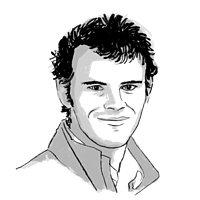
Supreme Court Justice Clarence Thomas broke a decade-long silence from the bench on Monday, provoking audible gasps in the chamber and, perhaps, indicating that he may be more willing to speak up in the future following the death of Justice Antonin Scalia earlier this month.
Justice Thomas's remarks came near the end of oral arguments in a case regarding a federal law that bans people convicted of domestic violence from owning guns.
Ten minutes from the end of the hourlong session, Thomas asked Justice Department lawyer Ilana Eisenstein whether a misdemeanor conviction of any other law "suspends a constitutional right," prompting gasps from lawyers and journalists in the chamber. Thomas and Ms. Eisenstein then engaged in a back-and-forth for a few minutes.
Thomas hadn鈥檛 asked a question in the Court since Feb. 22, 2006 鈥� an unparalleled achievement in modern times ("it has been at least 45 years since any other member of the court went even a single term without asking a question," the New York Times this month).聽
For his part, Thomas has argued in that time that he doesn鈥檛 need to ask questions of lawyers in court, relying on written briefs to form his opinions.聽
"I don't think it鈥檚 helpful" to ask questions before deciding cases, he said during a in 2013. "I think we should listen to lawyers who are arguing the cases."
At best, Thomas's monkish silence has been viewed as a curious eccentricity. At worst, it has been viewed as a serious abdication of responsibility that disrespects the Court and his fellow justices.
On the eight-year anniversary of Thomas鈥檚 last question, the New Yorker's Jeffrey Toobin 聽that the silence had "gone from curious to bizarre to downright embarrassing, for himself and for the institution he represents."
"His leather chair is pitched so that he can stare at the ceiling, which he does at length," Mr. Toobin continued. "He strokes his chin. His eyelids look heavy. Every schoolteacher knows this look. It's called 'not paying attention.'"
Other court observers disagree, noting that Thomas can often be seen conferring with Justice Stephen Breyer, his neighbor on the bench, during arguments.
"It's pretty obvious he is engaged," said Ilya Somin, a law professor at George Mason University in Fairfax, Va., in with the American Bar Association Journal. "It's also obvious he's engaged from the opinions he writes."
Monday marked only the second week the nation's highest court has heard arguments since Justice Scalia's death. Scalia, who sat next to Thomas for seven years, was renowned for frequently questioning lawyers with energy and aggression.
The two were friends 鈥� Thomas was one of only two people invited by Scalia鈥檚 family to read from Scripture at his Feb. 20 funeral 鈥� and, ideologically, almost twins. With Scalia鈥檚 chair now empty 鈥� potentially for a 聽鈥� Thomas may decide to speak more and fill the void left by his friend and fellow conservative.
Scalia was famous for his "originalist" principles as a justice, a method of constitutional interpretation that seeks to interpret the Constitution as it was understood by the Founding Fathers. Yet Mr. Toobin wrote that, on paper, Thomas is "the most extreme originalist on the Court," adding that Thomas鈥檚 influence is palpable in some of the Court鈥檚 more conservative rulings.
Scalia wrote the majority opinion for District of Columbia v. Heller, a 2008 ruling that restricted gun control, while Justice Anthony Kennedy wrote the majority opinion for the Citizens United ruling in 2010, which loosened restrictions on campaign financing.
However, "Thomas was an intellectual godfather of both decisions," Toobin wrote.
Ralph Rossum, a professor at Claremont McKenna College in California who has written books on Justices Scalia and Thomas, told the ABA Journal in an interview that "at the end of the day I am convinced that Thomas is much deeper and much more serious than Scalia."
Whether he speaks or not, Prof. Rossum added, Thomas "is moving the court in his direction." Whether he will speak more in Scalia鈥檚 absence remains to be seen.
Material from the Associated Press was used in this report.