Much of the West is on tenterhooks about a Russian invasion of Ukraine. But at the front lines, where Ukrainian troops face Russia-backed separatists, it all feels like part of the routine.
Our name is about honesty. The Monitor is owned by The First Church of Christ, Scientist, and we鈥檝e always been transparent about that.
The church publishes the Monitor because it sees good journalism as vital to progress in the world. Since 1908, we鈥檝e aimed 鈥渢o injure no man, but to bless all mankind,鈥 as our founder, Mary Baker Eddy, put it.
Here, you鈥檒l find award-winning journalism not driven by commercial influences 鈥 a news organization that takes seriously its mission to uplift the world by seeking solutions and finding reasons for credible hope.
About usAlready a subscriber? Log in
Already have a subscription? Activate it
Join the Monitor community.
Subscribe
David Clark Scott
If most of the athletes in a pro sport are Black, shouldn鈥檛 the leadership be too?
In fact, the NBA has made significant strides: Eighty-three percent of the players are people of color, and so are half of the head coaches, according to 听
But the NFL鈥檚 ratios are way off. About 70% of the players are Black, and as of today, only 6% of the head coaches (two) are Black. Earlier this month, recently fired Miami Dolphins head coach Brian Flores sued the NFL over discriminatory hiring practices. The 58-page filing is a .
There are signs of progress in the NFL. and minorities are in assistant coaching positions. But Mr. Flores says lasting change has to come from the top down. Mr. Flores tells Rolling Stone. 鈥淭here are no Black voices in those meetings.鈥
Out of the 32 NFL team owners, two are minorities. None are Black. But that too may change. Several investors are reportedly interested in buying the Denver Broncos, but the NFL commissioner has been encouraging media mogul Byron Allen to buy a team since 2019, he says. 鈥 And for that reason, I will be making a bid for the Denver Broncos,鈥 he told Bloomberg last week.听
If Mr. Allen鈥檚 investment group succeeds, he鈥檇 be the first Black principal owner in the NFL. Could that be a catalyst for progress? Brian Flores says it will.听
Already a subscriber? Log in
Monitor journalism changes lives because we open that too-small box that most people think they live in. We believe news can and should expand a sense of identity and possibility beyond narrow conventional expectations.
Our work isn't possible without your support.
And why we wrote them
( 4 min. read )
Much of the West is on tenterhooks about a Russian invasion of Ukraine. But at the front lines, where Ukrainian troops face Russia-backed separatists, it all feels like part of the routine.
( 6 min. read )
Has a trend toward corporate bigness gone too far? The meat industry is becoming an important test as President Joe Biden and lawmakers in both parties consider regulatory changes. But the issues involved are complex.
( 4 min. read )
Germany鈥檚 test-heavy pandemic approach has morphed societal psychology to the point that testing听鈥 once a hot-button issue for a weary public听鈥 has now become part of everyday life.
( 5 min. read )
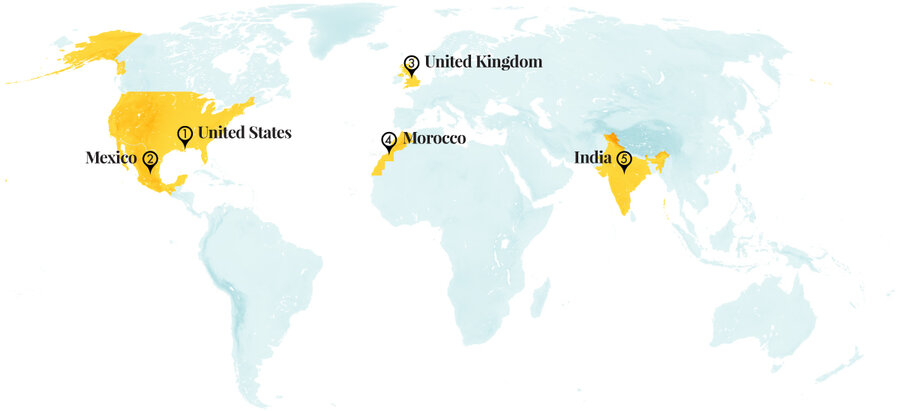
In our progress roundup, action on climate change and fossil fuels comes from the top down and bottom up. While Morocco鈥檚 rail system moves to renewables to power its fastest trains, citizens in New Orleans are building their own flood prevention mechanisms.听
( 3 min. read )
Across Nigeria, tensions between farmers and nomadic herders keep escalating, driven by a competition for land and water made worse by population growth and climate change. These skirmishes receive less attention than the region鈥檚 violent Islamist insurgencies. Yet they take a greater toll in killings and village disruptions, according to the United States Institute of Peace (USIP). They may also be one key to bringing peace in this region of Africa.
In at least two Nigerian states, new local peace agencies are quietly working with traditional leaders to stitch communities back together. Instead of security by military force, they are building what a mediator in the state of Kaduna calls 鈥渁n atmosphere of understanding鈥 through dialogue and reconciliation. Their successes show a way forward at a fragile turning point in efforts to suppress groups like Boko Haram and Islamic State.
For more than a decade, villages across the scrubby lower band of the Sahara desert called the Sahel have been caught in the crossfire between extremist factions and the military forces fighting them. Schools have been prime targets for jihadis looking for wives and conscripts. But civilians have also experienced violence from those who were supposed to protect them, according to human rights groups. And despite the presence of 12,000 United Nations troops and thousands of American and European forces, the problem has continued to spread.
The traumatic disruption of communities has created conditions that make people, particularly young men, more susceptible to radicalization. It is also causing a crisis of faith in democracy. In Mali, for example, the failure of international forces to contain extremism has turned popular opinion in favor of a ruling military junta even though 75% of the people say they favor democracy, according to the polling firm Afrobarometer.
The crisis deepened at a summit of European and African leaders in France this week. French President Emmanuel Macron announced he was withdrawing the 4,600 French troops based in Mali as part of an international counterterrorism operation. Critics called it an admission of failure. France has had troops in Mali to fight Islamist insurgents since 2013. But Mr. Macron said he could no longer side with 鈥渄e facto authorities鈥 that have lately embraced the arrival of some 800 Russian mercenaries. Denmark, Germany, and Norway are withdrawing their military support as well.
African leaders at the summit sided with Mr. Macron. Their opposition to the military junta in Mali reflects a shared conviction that lawlessness through military rule is not the answer to lawlessness. But it leaves unresolved how best to fix a security problem that has defied the use of international forces.
In Nigeria, communities responding to ethnic and religious strife from within may hold part of the answer. Peace initiatives like the ones bringing herders and farmers together 鈥渁re an instrument worth adapting elsewhere to strengthen democracies against the erosions of violence and extremism,鈥 USIP notes. They start slowly. State-sponsored mediators bring traditional leaders together to begin defusing suspicions. Gradually others are involved. Storytelling helps participants find common ground.
A decade of fighting Islamist extremism in West Africa has killed thousands and displaced millions from their homes. As Western and African leaders reassess a primarily military-based approach to countering terrorism, people in communities overrun by that violence are showing that divisions based on identity can be overcome. By restoring local currencies of trust and respect, they are learning how to put down their guns.
Each weekday, the Monitor includes one clearly labeled religious article offering spiritual insight on contemporary issues, including the news. The publication 鈥 in its various forms 鈥 is produced for anyone who cares about the progress of the human endeavor around the world and seeks news reported with compassion, intelligence, and an essentially constructive lens. For many, that caring has religious roots. For many, it does not. The Monitor has always embraced both audiences. The Monitor is owned by a church 鈥 The First Church of Christ, Scientist, in Boston 鈥 whose founder was concerned with both the state of the world and the quality of available news.
( 2 min. read )
Looking to God as the ultimate source of truth empowers us to let divine wisdom, not fear, guide us.
Thanks for joining us. On Monday, look for a special send with a sneak peek at our newest podcast, 鈥淪ay That Again?鈥 We鈥檒l be back with a new Daily on Tuesday,听with more on the听Ukraine crisis. And between now and then, our 鈥淔irst Look鈥 section is a place to go for breaking news.