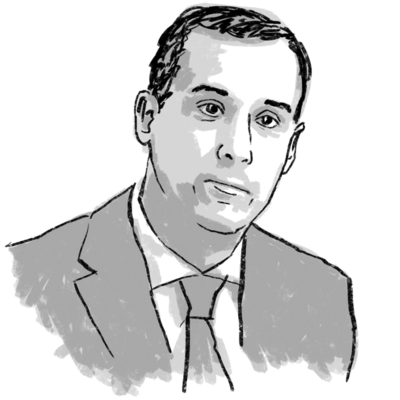
A spate of memoirs by former Trump aides has raised questions over loyalty to the boss and what it means to retain a seat on the president鈥檚 kitchen cabinet.聽

Our name is about honesty. The Monitor is owned by The First Church of Christ, Scientist, and we鈥檝e always been transparent about that.
The church publishes the Monitor because it sees good journalism as vital to progress in the world. Since 1908, we鈥檝e aimed 鈥渢o injure no man, but to bless all mankind,鈥 as our founder, Mary Baker Eddy, put it.
Here, you鈥檒l find award-winning journalism not driven by commercial influences 鈥 a news organization that takes seriously its mission to uplift the world by seeking solutions and finding reasons for credible hope.
Explore values journalism About usAlready a subscriber? Log in
Already have a subscription? Activate it
Join the Monitor community.
Subscribe
Arthur Bright
One would hope that after a catastrophe like Tuesday鈥檚 bridge collapse in Genoa, Italy, the authorities would be focused on helping those affected. But the Italian government has moved on quickly to apportioning out blame.
Matteo Salvini, the deputy prime minister and leader of the right-wing League, said today that those responsible would 鈥減ay, pay everything, and pay dearly.鈥
Among those he fingered was the European Union. 鈥淚f external constraints prevent us from spending to have safe roads and schools, then it really calls into question whether it makes sense to follow these rules,鈥 he said. 鈥淭here can be no trade-off between fiscal rules and the safety of Italians.鈥
Mr. Salvini鈥檚 choice to point a finger at the EU is not a surprise. The League is deeply euroskeptic. But his accusation is unfounded. As BuzzFeed Europe editor Alberto Nardelli tweets, the EU has for Italian infrastructure. But many Italian governments and parties chose not to spend that way.
Salvini鈥檚 government wasn鈥檛 apt to be different. Mr. Nardelli notes that a redevelopment project has long been debated for the Genoa bridge, but League coalition partner the Five Star Movement .
At least one former prime minister argued that debating bridge construction . 鈥淢aybe finally it is the time to discuss infrastructure, but without ideology,鈥 tweeted Matteo Renzi. 鈥淏ut today, please, is a day only for silence.鈥
Now to our five stories for your Wednesday.聽
Already a subscriber? Log in
Monitor journalism changes lives because we open that too-small box that most people think they live in. We believe news can and should expand a sense of identity and possibility beyond narrow conventional expectations.
Our work isn't possible without your support.
And why we wrote them
( 5 min. read )
A spate of memoirs by former Trump aides has raised questions over loyalty to the boss and what it means to retain a seat on the president鈥檚 kitchen cabinet.聽
( 6 min. read )
If Chicago builds a $95 million police and fire academy, how many problems can it solve? In the neighborhood with the city鈥檚 shortest life expectancy, some say that the facility will bring jobs, others that the money should be spent on education and social services.
( 5 min. read )
A Brazilian border state鈥檚 difficulties welcoming Venezuelans underscore a frequent challenge: communities hosting vulnerable refugees are often among their country鈥檚 neediest, too.
( 6 min. read )
Early learning advocates have given a lot of attention to preschool in recent years, but not as much to what comes after. Those who have studied the issue say full-day kindergarten is just as important.
( 5 min. read )
Historically, Hollywood has misrepresented Asians. Understanding how offers lessons on more authentically portraying minorities, eventually making movies like "Crazy Rich Asians" expected rather than exceptions.聽
( 3 min. read )
In quiet ceremonies next week, the people in the Czech capital of Prague will commemorate the 50th anniversary of an event that still reverberates across much of Europe. On the night of Aug. 20, 1968, the tanks and troops of the Soviet empire rolled into the city to end what was called the Prague Spring.
In the months before the Moscow-led invasion, the head of then-Czechoslovakia, Alexander Dub膷ek, had reversed some basic elements of Soviet ideology by reducing state control of industry and embracing the dignity of individuals in choosing their own form of government.
He had exposed the big lie of communism 鈥 namely that fear and domination were necessary to further a cause guided solely by a self-selected elite.
Dub膷ek was deposed by the Kremlin and communist rule was reinstated in Czechoslovakia. But the Soviet claim to historical supremacy was never the same. A bubble was popped. Moscow鈥檚 exercise of physical power in Prague, based on the Marxist notion of material values, ended up spawning a movement that relied on truth-telling, not guns or violent protests, as the real power.
The movement was led by a Czech playwright and dissident, V谩clav Havel. His greatest essay, 鈥淭he Power of the Powerless,鈥 asked people to 鈥渓ive in truth,鈥 using daily small acts to expose the fabrications of authoritarian rulers that force people to 鈥渓ive a lie.鈥
Consciousness, not material conditions, controls one鈥檚 being and freedom, he said. And hope 鈥渋s not the conviction that something will turn out well, but the certainty that something makes sense, regardless of how it turns out.鈥
By 1977, the movement led to a human rights organization known as Charter 77. It helped dissidents behind the Iron Curtain speak out about universal ideals and reveal the kind of falsehoods and fears that prop up dictatorships. By 1991, the Soviet empire had collapsed from within, largely without violence in its final fall. Mr. Havel then became the elected president of his fully independent and democratic nation (which later split into Slovakia and the Czech Republic).
The Prague Spring is just one important event of the cold war. Yet its 50-year legacy in truth-telling has carried over into many countries today that are battling the mass disinformation campaign of Vladimir Putin鈥檚 Russia.
President Putin鈥檚 ideology of ethnic nationalism and heroic authoritarianism is not communism. Yet it, too, relies on suppressing dissent and a controlled media while trying to undermine democracy in other countries, especially near Russia鈥檚 borders.
Since 2014, the biggest target of Russian propaganda has been Ukraine because it had liberated itself from Putin鈥檚 influence in the so-called Maidan Revolution and in its drive to eventually join the European Union. While Russia later took the Crimean Peninsula by force and still supports armed rebellion in Eastern Ukraine, it uses social media and other information outlets to bombard Ukrainians with fake news or half-truths that imply the country is run by fascists or that the West is the enemy.
This has led to many Ukrainians organizing themselves to learn how to fact-check news stories. The late Swedish researcher Hans Rosling calls this 鈥渇actfulness,鈥 or learning to discern what qualifies as real and achieve what he termed 鈥渦nderstanding as a source of mental peace.鈥
Ukraine鈥檚 leading fact-checking group is a project known as StopFake, started by journalists and others to counter fake news. It has nearly 200,000 followers on social media and runs programs on Ukrainian television.
With its success, it has begun to provide similar fact-checking in other countries, including Russia, that are the brunt of Kremlin propaganda. StopFake relies heavily on donations from abroad as well as local volunteers. One donor in particular stands out: the Czech Republic. Fifty years on, the events that started with the Prague Spring keep echoing into the future.
Each weekday, the Monitor includes one clearly labeled religious article offering spiritual insight on contemporary issues, including the news. The publication 鈥 in its various forms 鈥 is produced for anyone who cares about the progress of the human endeavor around the world and seeks news reported with compassion, intelligence, and an essentially constructive lens. For many, that caring has religious roots. For many, it does not. The Monitor has always embraced both audiences. The Monitor is owned by a church 鈥 The First Church of Christ, Scientist, in Boston 鈥 whose founder was concerned with both the state of the world and the quality of available news.
( 3 min. read )
A hostile situation at work yielded to collegiality and productivity as today鈥檚 contributor considered the idea that we all have the God-given ability to express qualities such as wisdom and integrity.
Thank you for accompanying our exploration of the world today. Please come back later this week for a pair of stories about how climate change is manifesting in ways one might not expect. Tomorrow, we'll look at its impact on the economy, and on Friday, we鈥檒l examine the way it鈥檚 changing how people choose to vacation.