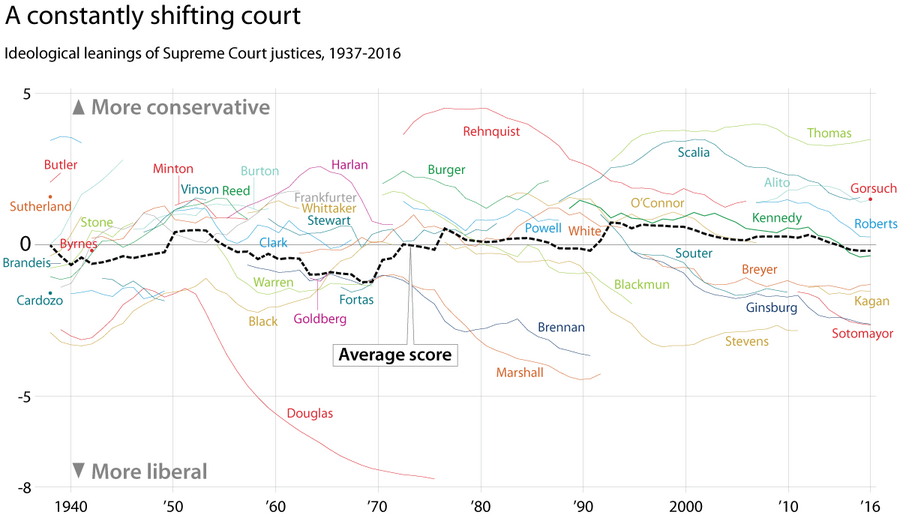
There is a growing perception on the part of voters that Supreme Court decisions are increasingly about setting policy, as opposed to interpreting the law. Will the replacement for Justice Anthony Kennedy boost that perception?
Our name is about honesty. The Monitor is owned by The First Church of Christ, Scientist, and we鈥檝e always been transparent about that.
The church publishes the Monitor because it sees good journalism as vital to progress in the world. Since 1908, we鈥檝e aimed 鈥渢o injure no man, but to bless all mankind,鈥 as our founder, Mary Baker Eddy, put it.
Here, you鈥檒l find award-winning journalism not driven by commercial influences 鈥 a news organization that takes seriously its mission to uplift the world by seeking solutions and finding reasons for credible hope.
About usAlready a subscriber? Log in
Already have a subscription? Activate it
Join the Monitor community.
Subscribe
Kim Campbell
Schools may be on break, but the effort to make progress on keeping students safe is not.
The Secure Schools Roundtable met on Capitol Hill today, sponsored in part by the two-year-old bipartisan .聽Key groups 鈥撀爄ncluding educators and students, lawmakers and law enforcement 鈥 were invited to in K-12 schools.
Student activists are also working to keep the topic in the public eye. Teens from Parkland, Fla. 鈥撀爓here Marjory Stoneman Douglas High School was the site of a mass shooting in February 鈥撀燼nd other students are on that kicked off on June 15 in Chicago and was headed for Bismarck, N.D., today. A separate is also happening in Florida, where yesterday officials in Broward County, which includes Parkland, to allow armed, non-law-enforcement guards in schools that don鈥檛 already have school resource officers.聽
One of the goals of the tours is to register more young people to vote. The students see that as a way to move forward on solutions to gun violence. We are keeping an eye on the momentum of youth activism, which is also addressed in several of our stories today. The movement is in a position to influence not only school safety, but also, it seems, elections.
Now to today's five stories.聽
Already a subscriber? Log in
Monitor journalism changes lives because we open that too-small box that most people think they live in. We believe news can and should expand a sense of identity and possibility beyond narrow conventional expectations.
Our work isn't possible without your support.
And why we wrote them
( 5 min. read )
There is a growing perception on the part of voters that Supreme Court decisions are increasingly about setting policy, as opposed to interpreting the law. Will the replacement for Justice Anthony Kennedy boost that perception?
Andrew D. Martin and Kevin M. Quinn. 2002. "Dynamic Ideal Point Estimation via Markov Chain Monte Carlo for the U.S. Supreme Court, 1953-1999," based on the 2017 Release 01 release of the Supreme Court Database and the SCDB Legacy 03 version of the Legacy Supreme Court Database
( 6 min. read )
Much like Republicans with the tea party, Democrats are being confronted by an energized left wing that could propel the party in upcoming elections 鈥 but also portend a growing internal divide.
( 5 min. read )
Climate change is often painted as a starkly partisan issue. But within the Republican Party, a generational divide has emerged, as some Millennials tug the GOP toward climate action.
( 6 min. read )
Social media can make activism as easy as the click of a mouse. Our reporter accompanied a group whose more demanding mission is to console the victims of Israeli-Palestinian violence in person.
( 7 min. read )
Role models, particularly those in schools, have a big impact on children. Persistent efforts to recruit and retain men of color are aimed at striking a real-world balance for school staff.聽
( 2 min. read )
One legacy that Justice Anthony Kennedy leaves as he retires after three decades on the US Supreme Court is some principled guidance on how to hold a dignified debate over choosing his successor. As members of the Senate arm themselves for a battle royal over President Trump鈥檚 nomination, they may want to build on, rather than ignore, his judicial legacy.
When he wrote the court鈥檚 official opinions, Justice Kennedy often sought a path for many of those who lost their legal case to see their views expressed in policy. This went far beyond his strong defense of free speech. Governance to him was not a zero-sum choice between the demands of the left and the right but rather a search to define what he called 鈥渢ranscendent鈥 attributes and the 鈥渟piritual imperatives鈥 necessary for a complex world.
Before Elena Kagan joined the high court as a justice, she described Kennedy as its most influential member because of his 鈥渋ndependence, his integrity, his unique and evolving vision.鈥 In many of the court鈥檚 biggest decisions, he was the swing vote, and for good reason. He sought to interpret the Constitution in ways that could ensure that the inner conscience of individuals and their outward responsibilities were not in conflict.
To achieve that, he relied heavily on the basic principles of liberty, privacy, and universal equality, then mixed all three to emphasize the intrinsic value of dignity.
In Kennedy鈥檚 focus on dignity 鈥 either to preserve it or bestow it 鈥 he saw the makings of social cohesion and healing. Or as he put it in a talk, 鈥淢ost people know in their innermost being that they have聽dignity聽and that this imposes upon others the duty of respect.鈥
Such thinking was usually evident, if not always accepted, in his most important rulings, such as those on campaign finance, same-sex marriage, religious exercise, and the rights of detainees at Guant谩namo Bay. In many cases, he saw the best course to ensure the continuance of dignity was to set boundaries on government power. In others, he saw such power as necessary to end any harm to dignity.
Dignity is not something defined from the outside. Each individual is endowed with it. Guarding it in the way Kennedy did can help engender respect for the dignity of others.
Dignity is not a source for division but, if recognized, can be the basis for what Kennedy calls the best interpretation of the 鈥渕andates and promises鈥 of the Constitution. 鈥淚 am searching, as I think many judges are, for the correct balance in constitutional interpretation,鈥 Kennedy stated.
Dignity was his lodestar. And perhaps it can also be the starting point for the coming national discussion over his replacement.
Each weekday, the Monitor includes one clearly labeled religious article offering spiritual insight on contemporary issues, including the news. The publication 鈥 in its various forms 鈥 is produced for anyone who cares about the progress of the human endeavor around the world and seeks news reported with compassion, intelligence, and an essentially constructive lens. For many, that caring has religious roots. For many, it does not. The Monitor has always embraced both audiences. The Monitor is owned by a church 鈥 The First Church of Christ, Scientist, in Boston 鈥 whose founder was concerned with both the state of the world and the quality of available news.
( 3 min. read )
Today鈥檚 contributor found that seeking a more spiritual sense of her identity freed her from an unhealthy focus on her diet and weight.
Join us tomorrow, when we'll have a report from Lexington, Va., home of the Red Hen restaurant, where locals talk about how the debate on civility has had a dramatic effect on their lives this week.