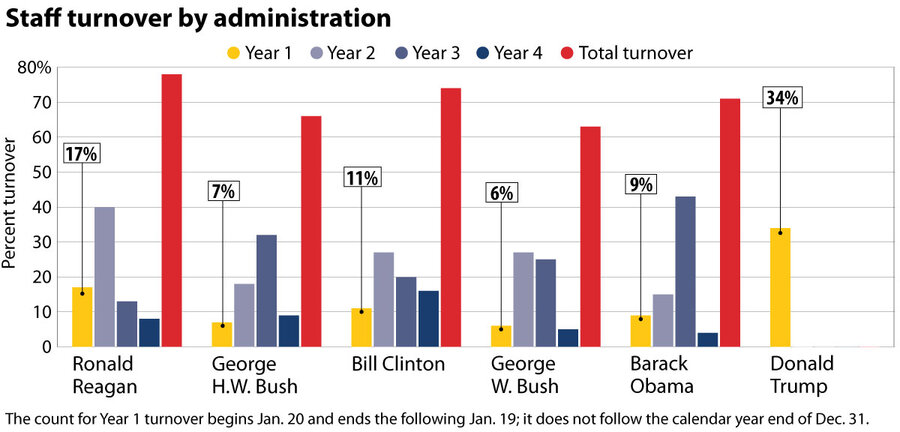
Where is the line between intentional disruption and chaos? It comes down to control. Staff departures 鈥 from communications officers to diplomats 鈥 are raising questions about the US administration鈥檚 ability to focus on governing.
Our name is about honesty. The Monitor is owned by The First Church of Christ, Scientist, and we鈥檝e always been transparent about that.
The church publishes the Monitor because it sees good journalism as vital to progress in the world. Since 1908, we鈥檝e aimed 鈥渢o injure no man, but to bless all mankind,鈥 as our founder, Mary Baker Eddy, put it.
Here, you鈥檒l find award-winning journalism not driven by commercial influences 鈥 a news organization that takes seriously its mission to uplift the world by seeking solutions and finding reasons for credible hope.
Explore values journalism About usAlready a subscriber? Log in
Already have a subscription? Activate it
Join the Monitor community.
Subscribe
Clayton Collins
This week you had to squint to see stories that didn鈥檛 make you squirm.
On top of the barbarity unfolding in Syria came a report that North Korea might be funneling to the regime. Russia boasted about having hypersonic and detection-dodging nuclear missiles (also unconfirmed). Temperatures in the Arctic hit while Europe shivered.
Pass the magnifying glass. But don鈥檛 spin the globe to those cultures where 鈥減rogressive鈥 benchmarks get .
Look to Iraq, a nation that has cherished literacy for decades. began as a volunteer on a male-dominated bookshop row in Baghdad. Now, the 29-year-old broadcasts a weekly TV segment on new books and has published half a dozen herself, including titles examining the role of Iraqi women in society.
Look to Russia, where interest and activism are spreading around , which holds about one-fifth of the world鈥檚 unfrozen fresh water. 鈥淔irst of all,鈥 the longtime director of a nature reserve there told The Economist, 鈥渨e see that it concerns the kids now.鈥
Look to Ireland, where in its political evolution with the election of Mary Lou McDonald as president after Gerry Adams鈥檚 long and controversial run. She's a different face for the party, a Dubliner with middle-class roots, no connection to the IRA, and a reputation as an effective parliamentary reformer.
All worth watching closely.
Now to our five stories for your Friday, including a special narrative report on the power of forgiveness.
Already a subscriber? Log in
Monitor journalism changes lives because we open that too-small box that most people think they live in. We believe news can and should expand a sense of identity and possibility beyond narrow conventional expectations.
Our work isn't possible without your support.
And why we wrote them
( 5 min. read )
Where is the line between intentional disruption and chaos? It comes down to control. Staff departures 鈥 from communications officers to diplomats 鈥 are raising questions about the US administration鈥檚 ability to focus on governing.
( 5 min. read )
The new tariffs placed on imports of aluminum and steel by the Trump administration represent a rejection of status-quo trade policies 鈥 even of using a multilateral approach to pressuring China. What's less clear is whether the proposed replacement approach has a workable endgame.
( 5 min. read )
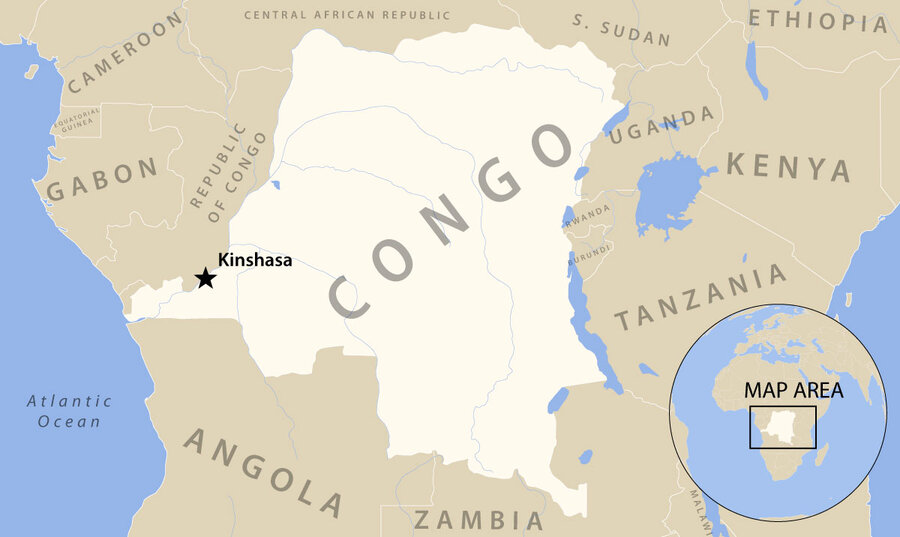
As President Kabila's rule has dragged on, the Catholic Church鈥檚 role in the political crisis has shifted from moral condemnation to active resistance. That鈥檚 even more remarkable in this context: Historically, the church was a state partner. Having a steady presence doesn鈥檛 mean standing still.
( 17 min. read )
Writer Harry Bruinius went to Baltimore in January to report on the city鈥檚 record-high murder rate. It would become his most wrenching assignment. At a gathering of mothers affected by the violence he heard forgiveness 鈥 and gratitude for forgiveness. 鈥淚n a deeply emotional moment,鈥 Harry says, 鈥渢here was a jolt of hope.鈥 In a series of conversations, two mothers shared with him their interwoven stories. The result was this remarkable piece about taking steps toward healing.
( 7 min. read )
The apparent reversal of progress merits attention, too, so that signs of its replication can be addressed. This last piece is really 鈥渁 canary in a coal mine story,鈥 our Europe editor says, about how xenophobia has crept into the area around Schio, Italy 鈥 a place where the integration of 鈥渙utsiders鈥 has been working for decades.
( 3 min. read )
In proposing high tariffs on imports of steel and aluminum, President Trump has cited three reasons for his trade protectionism. One is political: It would fulfill a campaign promise to bring back metal-factory jobs. Another is economic: It would revive a lost piece of the total economy in the Rust Belt. A third is strategic: It would help retain a material supply for national defense.
All three reasons are widely disputed by many experts, including some in his own administration. More jobs will be lost than gained, they say. Metalmaking is not as vital to the economy as in the past. And, they add, such an arbitrary rule would damage national security by offending both allies and adversaries as well as ignite a global trade war.
So far, none of the arguments have turned Mr. Trump away from his plan. In fact, he responded by saying he welcomes a trade war because it would be 鈥渆asy to win.鈥 He threatened more import tariffs against any country that imposes a duty on United States goods or services.
Yet the president also offered a fourth reason for his proposal, one that might open a door for negotiations and a way to find common ground.
By his own moral sense, Trump believes the tariffs will restore some reciprocity in trade relations. He cites 鈥渃heating鈥 by China and other nations that are accused of selling steel abroad below the cost of making it and of stealing key technologies. He also cites past trade agreements that allow countries to effectively block competition from American companies.
Trump is hardly alone in demanding reciprocity. 鈥淲e are committed to free trade, but it must be reciprocal,鈥 says German Chancellor Angela Merkel. Britain is in the throes of negotiations with the European Union over its trade relations as it prepares to exit the EU.
People have a deep desire for reciprocity in all relationships. It underlies notions of justice, equality, and the social contract. In trade agreements between nations, reciprocity is the moral foundation that helps determine how to reward each country鈥檚 abilities to produce goods and services. A society, wrote Plato in The Republic, 鈥渨ill be more abundant and the products more easily produced and of better quality if each does the work nature has equipped him to do....鈥
In demanding a new norm of fairness in trade, Trump is expressing a moral value as well as his economic, political, and strategic justifications for the tariffs. The probable practical effects of his proposal should be disputed. But the starting point of any negotiation needs to be a broader understanding of the intrinsic value of reciprocity.
Such a discussion goes beyond defining tit-for-tat fairness. It involves the greater good available when all sides accept reciprocity as a moral foundation, one that requires each side to acknowledge the other鈥檚 interests. Commercial trade is not always a zero-sum game in which some lose, some win. It is as much a social contract as an economic deal. At the least, the president deserves a hearing on his moral concern.
Each weekday, the Monitor includes one clearly labeled religious article offering spiritual insight on contemporary issues, including the news. The publication 鈥 in its various forms 鈥 is produced for anyone who cares about the progress of the human endeavor around the world and seeks news reported with compassion, intelligence, and an essentially constructive lens. For many, that caring has religious roots. For many, it does not. The Monitor has always embraced both audiences. The Monitor is owned by a church 鈥 The First Church of Christ, Scientist, in Boston 鈥 whose founder was concerned with both the state of the world and the quality of available news.
( 4 min. read )
Today鈥檚 column explores the idea that men and women have the inherent ability to overcome moral weakness and live more in line with our genuine selfhood as God鈥檚 good and complete children.
Enjoy the weekend, and come back around on Monday. In his "Patterns" column, Ned Temko will be looking at聽issues of immigration, asylum, and nativism in Western politics 鈥 a confluence of forces that could undermine the post-1945 consensus about聽the benefits of international cooperation and integration.
Also, as film fans wonder what to expect at Sunday鈥檚 Academy Awards 鈥 including any statements on racial- and gender-diversity issues 鈥 here鈥檚 a short Oscars briefing. It also looks at the chatter around best picture.聽