Despite tariffs, global trade keeps growing – just with new partners

| Boston, Rio de Janeiro, Toronto, Beijing, and Mexico City
The ingredients for deglobalization are all there: rising tariffs, growing wariness of reliance on other nations for key goods, and the world’s top two economies weaponizing international commerce.
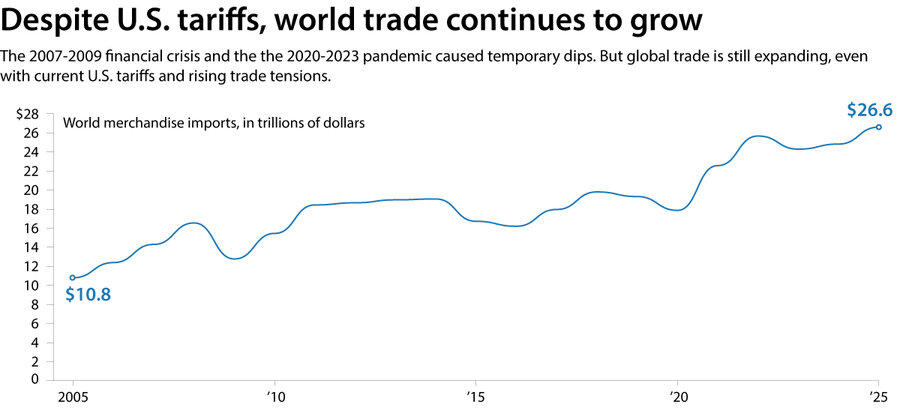
And yet, world trade is proving remarkably resilient.
One year after President Donald Trump announced a raft of tariffs on a slew of countries intended to “free� the United States from dependence on foreign goods, using the moniker “Liberation Day,’’ global trade continues to expand and set records. The pace of that expansion is likely to slow this year. But it’s not reversing direction.
Why We Wrote This
President Donald Trump’s tariffs were aimed at strengthening America’s economy and trading position. But they are also prompting a profound restructuring of global supply chains, with trade continuing to set records even without American or Chinese partnerships.
“Trade is a little bit like water,� said Cecilia Malmström, a former European commissioner for trade, speaking at a trade webcast this month hosted by the Peterson Institute for International Economics, where she is a nonresident senior fellow. “It finds new ways all the time� to circumvent obstacles that governments impose on it.
This new trade order is messy. And it was made messier in February, when the U.S. Supreme Court struck down as illegal an array of tariffs imposed by Mr. Trump through executive orders. The administration quickly imposed temporary tariffs of up to 15% on all countries as a stopgap measure, and it is working to reinstate permanent ones using different presidential authorities.
Nations are unlikely to stop diversifying because of America’s state of flux. But they are just as unlikely to back away from trade with the U.S. and China. And the two behemoths still traded with one another to the tune of more than $400 billion last year.
Instead, other nations are making a conscious push to diversify beyond U.S. tariffs and China’s chokehold over strategic industries as a way to reduce risk in uncertain times. That pressure, especially from the U.S., is accelerating the diversification.
Finalizing new deals
In one of the most striking examples, the European Union spent more than 25 years trying to finalize a trade agreement with Mercosur, the Southern Common Market made up of Argentina, Brazil, Paraguay, Uruguay, and, since 2024, Bolivia. Finally, in January, they signed a provisional deal that drops tariffs immediately, beginning Friday, while the individual nations formally endorse the agreement.
Despite lingering questions from the European Court of Justice about the agreement, Márcio Elias Rosa, Brazil’s minister of development, industry, commerce, and services, said during a recent interview that he foresees “no difficulties� in the deal being fully approved in the long run. “This is perhaps the largest economic bloc to form in recent times,’’ he said. “We are talking about 720 million people who will be connected through a free trade agreement.�

Mercosur’s dealmaking predates Mr. Trump’s second term; the bloc signed a deal with Singapore in 2023. But Mr. Trump’s 40% tariff on Brazilian exports to the U.S. last year has added urgency to that nation’s push to diversify its export markets. Last year, Mercosur signed a free-trade agreement with the European Free Trade Association (Iceland, Liechtenstein, Norway, and Switzerland).
“Brazil is at the center of the China-U.S. clash, since both countries are its two top trading partners,� says Roberto Simon, a nonresident fellow on Latin America with the Stimson Center, a nonprofit think tank based in Washington. “It is heavily investing in bringing the Europeans closer ... and actively trying to expand relations with the GCC [Gulf Cooperation Council] countries in the Middle East and with India.�
Foreign Minister Mauro Vieira, representing Brazilian President Luiz Inácio Lula da Silva, was set to sign the EU-Mercosur agreement into law in a ceremony in Brasilia on Tuesday afternoon.
The export-dependent EU is also pushing to diversify markets for its goods. Besides its agreement with Mercosur, the bloc concluded trade deals with Australia and India this year and is advancing talks with Indonesia to both strengthen its Indo-Pacific economic partnerships and reduce its reliance on others. The EU is also updating an agreement with Mexico and negotiating with the Philippines, Thailand, and Malaysia.
Pressure from U.S. tariffs has also helped Indonesia push through domestic reforms and forge closer trade ties with its neighbors.
While U.S. tariffs hurt the Indonesian economy, an analysis by its government showed that retaliation would make matters worse. So, Jakarta adopted its own strategy: “The US is a problem, but hey, let’s expand trade with each other and with the rest of the world,� Mari Elka Pangestu, Indonesia’s former trade minister and now a professor of international economics at the University of Indonesia, said at the Peterson Institute event. “And this is exactly what we did.�
That nation, part of the Association of Southeast Asian Nations (ASEAN), saw exports grow more than 6% last year. It also finalized a deal with the U.S. in February that eliminates tariffs from both sides.
China’s game plan
China is pursuing its own diversification strategy. While its exports to the U.S. have shrunk amid trade wars – dropping 20% last year alone – its overall exports have climbed robustly, with its trade surplus topping $1.2 trillion for the first time last year. So far this year, Chinese exports are running nearly 15% ahead of the same period last year.
Beijing accomplished this by boosting exports to rapidly growing markets in Southeast Asia, Africa, and Latin America, according to official customs data. The 11-nation ASEAN bloc has become a bigger trading partner with China than either the United States or the EU.
Underlying this trend is China’s massive, sophisticated, and increasingly automated manufacturing ecosystem, which makes it difficult for other countries to compete. Instead of building their own domestic manufacturing bases, many nations choose to buy inexpensive goods from China, experts say.
“China has turned manufacturing into a table tennis game,� says Li Shuo, a senior fellow with the Asia Society Policy Institute’s Center for China Analysis. “They will get all the gold medals.�
Under its new five-year economic plan, China is doubling down on advanced industrial manufacturing, while also seeking to upgrade legacy industries to keep jobs in China. Beijing is also working to tighten its control over global supply chains. In April, it issued new regulations expanding the government’s power to investigate and sanction foreign entities and individuals that restrict China’s supply chains.

“Governments like Malaysia, Indonesia, Thailand – they do not have the fiscal power to build supply chains like China. They basically just give that market to China,� says Dan Wang, the China director for the Eurasia Group, a political risk research and consulting firm based in New York. “It’s like a model that cannot be challenged.�
But that prowess is also fueling global concerns. Many developing nations worry that, because of China, climbing the industrial ladder is no longer a practical road to development. European and other developed countries are working to avoid becoming a dumping ground for excess Chinese production. Beijing’s control over economic chokepoints and its willingness to use them is stirring national security concerns, especially its near-monopoly over the processing of rare-earth minerals, critical to certain key industries.
Last week, the U.S. and the EU signed a new deal on critical minerals to reduce their dependency on China. “The United States and the European Union share a commitment to addressing the nonmarket policies and practices that have distorted critical minerals supply chains,� said U.S. Trade Representative Jamieson Greer.
Finding new partners
Increasingly, world leaders are speaking out against the might-makes-right trade order that the U.S. and China are carving out. Mr. Lula of Brazil has become a vocal defender of multilateralism. At a food fair in Brasilia last week, he quipped that he would give each of the presidents – Mr. Trump and Xi Jinping – a Brazilian jabuticaba tree, whose fruit is known for its calming properties.
Canadian Prime Minister Mark Carney, who generated global headlines with a winter speech at the Davos, Switzerland, economic summit, has warned that there is no going back to the global order once championed by the U.S.
“Many of our former strengths, based on our close ties to America, have become weaknesses,� he told Canadians in an online speech on April 19.
In his first year as prime minister, Mr. Carney claims to have signed 20 defense and trade deals across four continents, including one with China in January that the U.S. lambasted. On Monday, he announced Canada’s first-ever national sovereign wealth fund. Earlier this month, he announced a massive summit, inviting more than 100 global investors to Toronto this fall, aiming to attract billions of dollars in foreign investment for Canada.
World Trade Organization
The North American trade deal between the U.S., Mexico, and Canada, known as the USMCA, has shielded 85% of Canada’s exports to the U.S. from tariffs. But that agreement is due for review in July. On Monday, Mr. Carney convened the first meeting of a new advisory council he announced this month to deal with upcoming trade negotiations.
Mexican exports to the U.S. have also benefited from the USMCA shield. As the top U.S. trade partner, Mexico has worked to balance its relationships with both the U.S. and China. But moves such as its sweeping tariffs on Chinese goods at the start of 2026 show that it might be quietly prioritizing its relationship with its megapower next-door neighbor.
The Mexican levies, which can reach up to 35%, apply to some 1,400 products from China and other Asian countries that don’t have free trade agreements with Mexico. They’re intended to block “backdoor� access to the U.S. market.
Measures such as this are seen as setting the groundwork ahead of trilateral USMCA trade renegotiations this summer. Both Mexico and Canada are hoping to dial back the tariffs imposed by Mr. Trump since the beginning of his second term. But reports imply that U.S. tariffs won’t be reversed.
“Tariffs are here to stay,� Mr. Greer, the U.S. trade representative, told Mexico’s business community this month, according to Reuters. “President Trump likes them. We will never go back to a zero-tariff world.�